When you click on links to various merchants on this site and make a purchase, this can result in this site earning a commission. Affiliate programs and affiliations include, but are not limited to, the eBay Partner Network.
Is there a general goal for what vacuum should be at WOT? Is there a ballpark range that is consistent for stock engines from the factory or does it vary? I know it will be more than 0 but it can't be to much.
The reason I ask, I am doing some testing and experimenting on the controller for the Jetfire turbo. It works on a pressure difference between the vacuum side and pressure side of the compressor.
There really isn’t vacuum per se on the inlet of a turbocharged engine at WOT. From what I have read it takes a sensitive manometer to make measurements on the inlet (air filter) side.
But maybe I’m not understanding what you’re asking / doing.
There really isn’t vacuum per se on the inlet of a turbocharged engine at WOT. From what I have read it takes a sensitive manometer to make measurements on the inlet (air filter) side.
But maybe I’m not understanding what you’re asking / doing.
Yes, I am looking to buy a manometer but not for testing the vacuum at WOT. I am not sure how I would do that and get an accurate reading while driving it. There has to be some vacuum in the carburetor (pre compressor) even if it is a very small amount.
Eric, unfortunately the vacuum on the inlet side of a draw-through turbo like yours is somewhat unrelated to normal manifold vacuum. Even at idle the compressor is spinning and moderating any vacuum reading you'd see. That's why the stock gauge is on the outlet side and reads both vacuum and pressure, depending on boost.
Yes, I am looking to buy a manometer but not for testing the vacuum at WOT. I am not sure how I would do that and get an accurate reading while driving it. There has to be some vacuum in the carburetor (pre compressor) even if it is a very small amount.
You can get dynamic pressure from a pitot tube from an airplane. Might be able to rig a collar with one sitting in it on top of the carb.
You can get dynamic pressure from a pitot tube from an airplane. Might be able to rig a collar with one sitting in it on top of the carb.
A standard pitot tube will not deliver dynamic pressure since it only measures stagnation pressure. A pitot-static tube (on the other hand) will provide dynamic pressure since the difference between the stagnation pressure and the static pressure = dynamic pressure.
Eric, unfortunately the vacuum on the inlet side of a draw-through turbo like yours is somewhat unrelated to normal manifold vacuum. Even at idle the compressor is spinning and moderating any vacuum reading you'd see. That's why the stock gauge is on the outlet side and reads both vacuum and pressure, depending on boost.
But there has to be vacuum on the carburetor side of the turbo. This should not change with or without a turbo. Not looking for manifold vacuum at WOT. Yes, the turbo is always spinning but it is not creating any pressure or "suction" on the carburetor side in normal operation.
The controller, or "wastegate" on these have two diaphragms and chambers. One chamber is vacuum from the carburetor side and the other is boost pressure from the compressor outlet. The two react against each other to create the total PSI of boost. There is a spring that can be shimmed for more or less boost. In the past we just put it together and see what it will boost. If you need more you take it back apart and add a shim and put it back on the car. I have come up with a way to test this before putting it on the car but need a reasonable idea of what that vacuum reading is at WOT. I am thinking about pulling the hood off Melissa's car and putting a few gauges on it along the cowl for a few different readings. I need a dyno... Or a way to put a load on one on a test stand.
If I were a fabricator, I would make a brake rotor that attaches to the flywheel but I would just end up killing myself with rotor shrapnel
You can get dynamic pressure from a pitot tube from an airplane. Might be able to rig a collar with one sitting in it on top of the carb.
My reading would need to be what is between the venturi and the turbo inlet. If I hook something there I am curious is velocity would affect the reading? I am not all that smart in these kinds of areas. I am just trying to get accurate test results of these controllers before installing them.
I have another idea that may work but would take time to put together data. I could test them only on the pressure side and then see how that compares to real world use. The difference is going to be very little but the goal is 6.5 psi. Most of them from the factory was 5 to 5.5 but the system is safe to 6.5. Over that and it runs into safety system problems. The past trial and error method is to time consuming.
I don't know what exactly you're trying to accomplish here, but my suggestion would be to install something like a Holley Terminator computer and various sensors. I'm not saying to go fuel injection, but it would allow datalogging of the various sensors and allow you to see the effects of adjustments. An AFR would be extremely helpful. Watch this for an explanation
But there has to be vacuum on the carburetor side of the turbo. This should not change with or without a turbo. Not looking for manifold vacuum at WOT. Yes, the turbo is always spinning but it is not creating any pressure or "suction" on the carburetor side in normal operation.
The compressor is spinning any time the engine is running, so yes it does have an effect. My real point was that on an NA engine, the vacuum gauge can be used to identify internal engine issues such as a sticking valve due to the periodic "drop" that is shown on the vacuum gauge. The spinning compressor will "homogenize" this signal and mask any such indications. I guess I'm not really sure what you're trying to determine here. As noted, there are various data acquisition systems available for race car telemetry that can support pressure and other readings. You might want to consider a mass airflow sensor, since that's the metric that really matters.
To answer the original question, I've heard a few different sources say 1.5" Hg is a good target for a 4 barrel N/A manifold vacuum at WOT. A 2 barrel would be 3" to 4".
How that would change on a draw through turbo I have no idea. My *assumption* is you'd expect higher vacuum since the turbo is actively pulling through the carb, but it really depends on how the airflow at that time compares to the flow capacity of the carb. I don't remember the Jetfire details so can't venture a guess. I'd assume they put on a small carb for efficiency/response, then expect the turbo to forcefully suck enough air to compensate on the top end.
You're just looking at total vacuum readings, so the more interesting stuff Joe is talking about is not strictly relevant. A port with a regular vacuum gauge is plenty. Just note that you'll need to know the readings at various RPM, as the airflow changes dramatically. So have a passenger that notes the vacuum at the start of a run and how it changes until you shift.
Oh, and that method of control (MAP (pressure in manifold) vs TMAP (pressure before inlet of turbo)) is still used on modern cars to calculate total air charge, and is used on typical turbo applications to control the blowoff valve and wastegate.
A standard pitot tube will not deliver dynamic pressure since it only measures stagnation pressure. A pitot-static tube (on the other hand) will provide dynamic pressure since the difference between the stagnation pressure and the static pressure = dynamic pressure.
Thank you, Norm, I meant the latter type but did not say.
Thanks guys, I am just going to have to hook a vacuum gauge to the throttle body and try it. Would for sure be good if I had that to log the information. I was not really wanting to go that far. I just need to know the vacuum reading before the turbo at WOT. I was hoping that maybe it was a standard across the board but I guess it is not. Till I know that reading I can't bench test the controller proper.
Darn things are sideways... This is what I am working with. Just trying to bench test this to find the proper boost pressure before assembly. It is mostly boost pressure that moves the controller but there is still a slight vacuum on the other side affecting it as well. I will just have to test the car to see if I can determine what that amount of vacuum is. I was just hoping that there was a general rule I could start with. Obviously not.
I did say 1.5" is typical for a 4 barrel. For this, I would assume a bit higher, so probably in the 3" realm. If I recall correctly, 2"Hg ~= 1psi, so that'd be about 1.5 psi pulling on the back side with 5 to 6 pushing on the front.
But, remind me, what's the flow rating on the carb and the HP rating of the motor?
But yeah, I would add a vacuum gauge to that "compressor inlet pressure" passage as a quick experiment.
I did say 1.5" is typical for a 4 barrel. For this, I would assume a bit higher, so probably in the 3" realm. If I recall correctly, 2"Hg ~= 1psi, so that'd be about 1.5 psi pulling on the back side with 5 to 6 pushing on the front.
But, remind me, what's the flow rating on the carb and the HP rating of the motor?
But yeah, I would add a vacuum gauge to that "compressor inlet pressure" passage as a quick experiment.
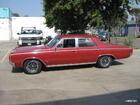
The engine is claimed to be 215 from Oldsmobile. I have no idea what the cfm of these carburetors are. I would like to put a vacuum gauge on that port but there is no way to do it sadly. This controller is mated right to the turbo with O rings between them. I do have a port just before the turbo that I could hook to. This port is for power brake cars. This power brake port is in the throttle body and about an inch from where the vacuum port in located on the turbo inlet. The reading should be the same between the two ports.
The engine is claimed to be 215 from Oldsmobile. I have no idea what the cfm of these carburetors are. I would like to put a vacuum gauge on that port but there is no way to do it sadly. This controller is mated right to the turbo with O rings between them. I do have a port just before the turbo that I could hook to. This port is for power brake cars. This power brake port is in the throttle body and about an inch from where the vacuum port in located on the turbo inlet. The reading should be the same between the two ports.
I'm sure you realize this but the pressures you would measure at any of the locations you're suggesting would be very dynamic and all over the map. Too much fluctuation, even at steady state conditions, to get an accurate reading. It's typical to use an array of sensors upstream or downstream of the turbo (~2-3x pipe diameter) and average readings over time. Common wastegate valves today are very similar to this simple spring loaded diaphragm but they only operate on compressor outlet pressure. They're set for a given boost pressure. The OE valves used to be adjustable but regulations forced a change to 'non-customer adjustable' within the last 10 years.
I respect your desire to bench test/set the wastegate but I think your most efficient approach to dialing it in will be trial and error on engine. Just out of curiosity, how thick are the shims you plan on using?
WoW! Reading all the great replies and expressed knowledge has me smiling to beat all gettout. Yes. We are talking about Oldsmobile rocket science here. Not sure of where we are going, but it will be fast and thrilling , just the same. Drive on------ REO
I'm sure you realize this but the pressures you would measure at any of the locations you're suggesting would be very dynamic and all over the map. Too much fluctuation, even at steady state conditions, to get an accurate reading. It's typical to use an array of sensors upstream or downstream of the turbo (~2-3x pipe diameter) and average readings over time. Common wastegate valves today are very similar to this simple spring loaded diaphragm but they only operate on compressor outlet pressure. They're set for a given boost pressure. The OE valves used to be adjustable but regulations forced a change to 'non-customer adjustable' within the last 10 years.
I respect your desire to bench test/set the wastegate but I think your most efficient approach to dialing it in will be trial and error on engine. Just out of curiosity, how thick are the shims you plan on using?
The only reading I need is the vacuum reading at wide open throttle before the turbo. That should be consistent for the most part.