When you click on links to various merchants on this site and make a purchase, this can result in this site earning a commission. Affiliate programs and affiliations include, but are not limited to, the eBay Partner Network.
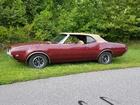
I have a 69 Cutlass with a 455, 3.23 Posi rear, Edelbrock manifold and 4-barrel. I'm sure a cam has been swapped but nothing radical. My speedometer is way off so I can't actually determine mileage driven but I swear I can't be getting more than a few miles to the gallon. The gauge drops noticeably on just a short drive. If I didn't know better I'd think I had a hole in the tank. The exhaust doesn't seem rich and I've pulled plugs and replaced them and they weren't black. Just wondering what mpg is common for this set-up? If I could only get 9-10 I'd be thrilled. Any suggestions?
The first step to a cure is to know the symptoms. Without knowing your actual mileage to start with, how can you determine an improvement. There are a lot of things that can cause black spark plugs.
That should be about normal, Probably, can do even better. Need to get the speedometer fixed to be able to tell exactly, what kind if mileage. In 1980, I bought a BB 454 Vett. IT ran tough, but got about 4to 5 miles per gallon. Took the carb apart, and the jets had been drilled out, they were huge, but car did not ping. All I did was put the correct size jets in, and it about doubled my mileage, to about 10-11. Was A fun car to drive.Also a good tune up, and set the timing will all help.
Harv I had a 74 BB Corvette and I didn't know a car could use that much gas. I never checked it real close but I think it was about 8-9 MPG. Of course 1974 was the worst mileage ever. It was a fun car to drive. Changing plugs on it was a challenge.
Mine was a 70 454, and the guy did a lot of mods to it, it was not factory settings, so just changing the jets to what was called for, is what helped the mileage.
buddy had an early 70's international pickup.you could literally see the gas gauge drop as you drove down the road.4-5mpg it would have been a gas miser
Get a friend to follow you and fill the car up at a gas station. Drive 30-50 miles and fill the car up again. Do this at least 2-3 times (beverages and food for friend and/or gas money.) That will give you a rough baseline of how many MPG you are getting. Then start looking at things like a fuel leak. Does the fuel drop while sitting? Is there any noticeable fuel along the gas line after driving? Then possibly look into the carb. Are you using a lead additive at all or have the valves been hardened for unleaded?
A carburetor is not the most fuel efficient form of fuel delivery, however, a well tuned carburetor and motor can greatly improve performance. Adjust the carburetor with a vacuum gauge....then if you want to completely dial it in, add a wide band air/fuel gauge(about $300-$400). It's not just the carb, check the rest of the tune as well. There are dozens of threads here and on the web outlining complete tuning.
I can literally watch the gas gauge drop as I wind it thur the gears at WOT.........
I recall the same thing with my 70 Supreme back in high school. My Mom had driven the car and filled the tank (thanks, Mom!) and didn't put the cap back on correctly, so every time I floored it gas was spilling out the filler neck.
This has been discussed before, and very recently. Get the speedo fixed so you can calculate how many miles you drive. Then fill the tank, drive the car, refill, and divide mileage by gallons needed to refill. On my Olds, I can drive 75 miles before the needle ever comes off full, then another 250 or so to drop to empty. My Ram truck is kinda the same way. You can drive 100 miles with the low fuel light on, fill up, and it still takes 30 gallons to fill a 36 gallon tank. I’m guessing Dodge wanted to make it very hard (or the driver needs to be really inattentive) to run the Diesel engine out of fuel!
My point is without accurate mileage and gallons used, you have no way of knowing what the mileage actually is. And to be really accurate, you need to do the math many times over many refueling stops. Maybe one time the pump shuts off early, leaving the tank less than full? Or another time you drove a long distance with a strong headwind, up a mountain?
Fill it up, go for a specific drive and use the gps app of your choice on your phone. Refill, record gallons, divide, get mpg without speedo.
Exactly, this will at least give an immediate idea of MPG. Till you remedy speedo issue...
Originally Posted by Aragorn
Are you using a lead additive at all or have the valves been hardened for unleaded?
Keep in mind the 455 never came in a regular Cutlass for 1969. Someone swapped that engine in, and it may already be a unleaded version.
Originally Posted by matt69olds
Maybe one time the pump shuts off early, leaving the tank less than full?
This is key, I have noticed several gallons difference between seeing the gasoline at the bottom of fill tube vs 1/2 way up the fill tube etc...
I have done extensive testing for MPG on my 69 with 350 CID, I take note of where in the fill tube the gas settles, and try my best to match it on subsequent refills. You will need a flashlight, and using the same pump will help minimize discrepancies. If not, at least use pumps with level appearing pavement. As a base line I would try to conduct mileage tests when traffic is reasonable, while driving by the book. Heavy traffic, excessive idling, can be a nightmare as far as fuel consumption goes for a carbureted engine.
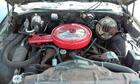
I would check timing and distributor curve as well. You should remove the carb and check throttle plate position also (pictured). There are tuning kits for Edelbrock carbs. A high float may cause bad fuel mileage but I believe you would see something on the plugs. A lean carb will require greater throttle opening to achieve power requirements. Check for damaged exhaust pipes. A vacuum gauge can diagnose lots of problems even a clogged exhaust.
I just want to say thanks for all the responses. Lots of time on my hands now to dig into this a bit more. I tried changing the driven gear fir the speedo but it wasn't enough. I need to do some more research and change the drive gear as well.
Well to my total amazement I filled up and did a drive, returned and filled up again. Since my speedo if off by 20mph at 60 mph I used mapquest to determine the distance and I use Waze as my speedo. It was all highway driving at 60mph which currently 3000rpm. So I went 17 miles and used 1.5 gallons. I am shocked to see I'm getting around 11mpg. I would have bet I was getting 5. Maybe around town that is closer to what it really is.
So just wondering what would be considered best mpg in a 455 somewhat modified?
A carburetor is not the most fuel efficient form of fuel delivery, however, a well tuned carburetor and motor can greatly improve performance. Adjust the carburetor with a vacuum gauge....then if you want to completely dial it in, add a wide band air/fuel gauge(about $300-$400). It's not just the carb, check the rest of the tune as well. There are dozens of threads here and on the web outlining complete tuning.
Actually, a carb is the most efficient method to fuel a engine, simply due to the Venturi. Air glowing thru the Venturi draws fuel out of the float bowl, atomizing the air/fuel mixture far better than spraying fuel out of an injector. The problem is a carburetor isn’t the most ACCURATE method. It’s really difficult (almost impossible) to tune a carb to deliver the perfect air/fuel mixture at every temperature, speed, altitude, engine load, etc. Pick one speed, one engine load, and never change the environment the engine is run, tune the carb for that application, and it will be perfect.
Now that you have a actual number, start optimizing the car. Make sure the tires are properly inflated, aligned, etc. Tune the engine, making sure the ignition is set up right. I bet you could fairly easily get the mileage up to 14-15 with minimal work.
My 69 will easily get 17-18 mpg, cruising at 75mph all day. My dads 455 powered 81 GMC gets 16, that’s a heavy square body truck with all the aerodynamics of a barn door.
I’ll say it again, it really doesn’t take much fuel to produce the power needed to push our A body cars at typical highway speeds. Those people who say the can’t get double digit economy numbers either can’t do simple math, or are to lazy or incompetent to properly tune a engine. Obviously, stop and go traffic is an entirely different matter, but straight highway cruising shouldn’t be all that bad.
I’ll say it again, it really doesn’t take much fuel to produce the power needed to push our A body cars at typical highway speeds. .
This is so true. A mildly built 462 makes an easy 450 HP. Next time you take your muscle car out for a drive, achieve a steady 50-55 MPH on flat ground. Holding the throttle steady, push in the clutch and watch the tach. My 442 only goes up about 1000 RPM because under that condition there is so little load on the engine.
According to This Source it takes about 20 HP to travel 65 MPH.