When you click on links to various merchants on this site and make a purchase, this can result in this site earning a commission. Affiliate programs and affiliations include, but are not limited to, the eBay Partner Network.
Trying to make an anodize stripping solution for some headlight bezels. If I mix 2lbs. of crystal lye with 3 gallons of water, what % of caustic solution will I have?
I've never heard of stripping anodizing with lye.
Most of the time aluminum trim parts are repaired, polished, and re-anodized.
The polishing removes the anodizing.
Trying to make an anodize stripping solution for some headlight bezels. If I mix 2lbs. of crystal lye with 3 gallons of water, what % of caustic solution will I have?
8% NaOH solution (908g NaOH/11340g H2O)
Where 908g = weight of 2 lbs NaOH (solute); 11340g = weight of 3 gals H2O (solvent)
3402g - 908g = 2494g
You will need to add an additional 2494g NaOH to 11340g (3gals) H2O to achieve a 30% NaOH solution
x/y = z
Where x = g NaOH; y= g H20; z = % x = 908g NaOH; y = 11340g H2O; then, 908g/11340g = 8% (0.08)
x = 3402g NaOH; y = 11340 H2O; then 3402g/11340g = 30% (0.30)
Last edited by Vintage Chief; May 14, 2024 at 09:41 AM.
Reason: stuff
I prefer to use grams to pounds, but this equation is simple if you remain in pounds (or you can make the equivalent adjustments in ounces if you like). Simple stuff, you just need(ed) to get your equivalents.
2lbs NaOH/25.02lbs H2O = 8% (0.08) NaOH solution
Again, simply solve for x
x/y = z
If z = 30% (0.30) what is x? x = y X z (25.02lbs X 0.30) = 7.5lbs NaOH
Therefore, 7.5 lbs - 2 lbs = 5.5 lbs. You'll need to add an additional 5.5lbs to a known 8% NaOH solution to achieve a 30% NaOH solution. Think about it logically & you can quickly do the math in your head. If 2lbs NaOH in 25lbs H2O = 8%, you know you'll need roughly x4 times that amount to achieve a 32% NaOH solution.
Last edited by Vintage Chief; May 14, 2024 at 10:03 AM.
Thanks Norm, impressive math skills For anyone following, the anodize is a very hard surface and very hard to just sand or polish off. 10 minutes in caustic solution and you can start polishing after any repair work.
Thanks Norm, impressive math skills For anyone following, the anodize is a very hard surface and very hard to just sand or polish off. 10 minutes in caustic solution and you can start polishing after any repair work.
Other than providing you with answer(s) to your question(s) regarding % NaOH solution, two caveats to consider in EZ-Off application(s):
(1) Do not use the EZ-Off Fume Free product as it contains no NaOH; and,
(2) Easy Off Heavy Duty Oven Cleaner Aerosol contains ≤10% NaOH. So a little less than the 30% solution you were after but should work effectively none-the-less. I use the Easy Off Heavy Duty Over Cleaner Aerosol to clean engine parts (intake manifold etc. made of iron). I've never used it to remove the Al anodized layer.
JoeP told be Wal-Mart sells an oven cleaner much less expensive than Easy Off. I'll see if it I can find it.
Us common folk call oven cleaner Sodium Hydroxide, used in bluing salts for bluing guns and a bunch of other cleaning tasks, and it will make any aluminum you have mistakenly left in the salts disappear..Tedd
This common folk just uses soapy paper towels to clean all the oven he can, then runs the cleaning cycle and gets the ash later. That serious of an oven cleaner makes me wonder about the grease fire in waiting that needed it in the first place.
Not to be a jerk (although it does come easily), that mix would be a 7.41% solution. 908g/(11,340g + 908g) = 908g/12,248g = 0.0741.
You are absolutely correct & you're not being a jerk. I was trying to keep it as simple as possible w/in reasonable terms of a weight-weight ratio which most could follow in an automotive forum.
I trust we aren't next going to determine heat of enthalpy of this Rxn?
I was amazed at how warm it got when I mixed in the first 2 lbs. of lye. Getting ready to add 2 more lbs. ,is it going to get even hotter?
Dissolving lye (NaOH = Sodium Hydroxide = solute) into H2O (solvent) is a highly exothermic Rxn releasing energy in the form of heat. You should always add the solute (NaOH) to the solvent(H2O) slowly. Just as you would with a strong acid such as HCl (Hydrochloric Acid = Muriatic Acid). You would never want to add water to NaOH or water to HCl. You add the solute (e.g. NaOH) to the solvent (e.g. H2O).
In chemistry we say: "Do as you oughta, add acid to water". This provides a simple mental cue to assist in abiding by safety rules when dealing with strong bases and strong acids, but it should be used whenever you're mixing solvents and solutes to create a solution.
Getting ready to add 2 more lbs. ,is it going to get even hotter?
Next two pounds will give you a little less temperature increase, only because your solution is now 27-lbs, versus the 25-lbs of water you began with. Be careful, and eye protection is a must!
There's obviously no manner to tell what someone's background is when working with nearly anything - albeit, I just answer questions. As F-85 stated wear gloves & eye protection - always.
To be clear. A strong base (NaOH) solution burn is FAR, FAR more damaging to your body (especially mucous membranes) than a strong acid burn. Bases will literally eat away your adipose (fat) tissue in a heart beat and continue eating (dissolving) it deeper and further. You'd much prefer to have an acid burn than a base burn. None-the-less, with that said:
(1) Clearly label the NaOH solution container - VERY CLEARLY IN LARGE PRINT
(2) NEVER store a strong base (NaOH) solution or strong acid solution above ground. ALWAYS store them at ground level.
(3) Both strong acid solutions and strong base solutions REQUIRE a lid.
I guess I'm not really beating it to death if I'm referring to safety - so, I'll rant one more time in the name of safety.
Accidents happen. If yourself or anyone should spill Sodium Hydroxide solution on themselves, IMMEDIATELY run large copious amounts of COOL water (not warm, not hot) over the area of skin. Bases (e.g. NaOH solution) like bleach (Sodium Hypochlorite) are slippery to the touch. Continue running cool water over the area of skin during the 1st hour - every 15' to 20'.
Got the first one stripped. Had to add another gallon of water to keep bezel submerged so now I have 4 gallons of solution. Added 3 lbs. more of lye so according to my calculation I now have around 15% solution. The bezel below was submerged for 15 minutes and it appears to be stripped pretty good. Now the hard part, sanding and removing factory flaws, then polishing before anodizing.
First lesson learned when stripping anodize, sand or brush the black trim paint off first. Where the black gets left anodize remains and you have to dip it again in the solution.


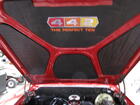
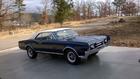


 For anyone following, the anodize is a very hard surface and very hard to just sand or polish off. 10 minutes in caustic solution and you can start polishing after any repair work.