When you click on links to various merchants on this site and make a purchase, this can result in this site earning a commission. Affiliate programs and affiliations include, but are not limited to, the eBay Partner Network.
You know, if you're going to work on this car, you REALLY should get a factory Chassis Service Manual and read it...
That is a vacuum reservoir. The flapper doors in your HVAC system are vacuum operated. That reservoir serves to maintain enough vacuum to operate the HVAC system when manifold vacuum drops during wide open throttle. The CSM has the vacuum hose diagram.
Okay I bought 6 Feet and probably need more tubing, installed what the diagram shows but still not sure if I got the right ones in the right connections. Which diagram is for the Big Cowl injection with AC?
thank you
Well, open that CSM to page 1C-13 and look at Figure 1C-23 at the top of the page. It shows you EXACTLY where every hose connects to.
Joe Padovano, I looked at the picture you are referring too, is the first one I posted and doesn't show where and what its connected too. its just hanging there with no connection or name..... or I'm looking at the wrong picture?
I know another member said in the Intake manifold but where? the one in front of the carburetor is already taken.
Vacuum operated accessories connect to manifold vacuum. ANY port on an intake runner is the same manifold vacuum. Unless you are performing a 1000 point restoration, it doesn't matter. Just pick a port on an intake runner. The square item at the end of the hose in the first diagram you posted is one of the brass fittings shown on the left in this photo. It screws into one of the many ports on the intake. Pick one.
Vacuum operated accessories connect to manifold vacuum. ANY port on an intake runner is the same manifold vacuum. Unless you are performing a 1000 point restoration, it doesn't matter. Just pick a port on an intake runner. The square item at the end of the hose in the first diagram you posted is one of the brass fittings shown on the left in this photo. It screws into one of the many ports on the intake. Pick one.
Joe can it go here? in the picture its in the back of carb? thank you for your help, the last time i had this car was when i was 19.
Hondo, Joe will know for sure, but that high on the carb, it looks like that is ported vacuum.
Ported vacuum is vacuum that is there only when the throttle blades are open, because it is "above" the throttle blades. So, you don't get it at idle.
Manifold vacuum is below the throttle blades, and you have it when the engine is on. For HVAC you want manifold vacuum. I think that is an extra little T on ported vacuum that doesn't look stock.
You are looking for a bolt plug on the intake manifold's runners for a source of manifold vacuum.
That isn't a vacuum port at all, it's a vent port for the TCS. Come on guys, I can see the correct square brass fitting down on the intake runner in that photo.
Your intake should have THREE vacuum taps on that rear runner between the distributor and the carb. See the attached photo.
JOE, this is what I got? If you see a Mistake Please Correct me. the Vacuum Reservoir still not hooked up because I dont know which other one I have to T too?
JOE, this is what I got? If you see a Mistake Please Correct me. the Vacuum Reservoir still not hooked up because I dont know which other one I have to T too?
And THAT'S your problem. The hose from the rear of the TCS solenoid does not run to the vacuum tap on the intake runner. It runs to that open port at the top rear of the carb. This is why you don't have the vacuum port you need for the HVAC. The diagram on page 6C-19 in the CSM tells you that port from the TCS solenoid connects to "Vent Port On Carburetor Air Horn".
so I also need to add a T to the Air Filter Housing and The Flapper? and also just re-route TCS to the top of carburetor like you said please check the picture I posted? Correct?
Im sorry but just want to get it right. all these tubes were already installed and missing when I purchased the Olds..
I really don't want to throw a wrench into this - but I will anyways.
Isn't that "port" at the top back of the carburetor not even ported vacuum? IMO, that "port" is nothing more than the port which pulls off clean/filtered air from the "top-side" of the carburetor (via/from the stove choke/vacuum assembly). The "port" gains it's air not from the air horn itself, (below the air horn plates) but instead via the cut-out chamber at the top center of the carburetor. It's nothing more than filtered air ("if" the air cleaner is installed). I might be incorrect about this, but isn't there supposed to be two ports on the back of this carburetor? They are rather close together; yet, one is lower (ported vacuum) and the other (as shown in this picture) is higher (filtered air)? Is this the correct carburetor for a sbo equipped with a TCS?
I've labelled the ported vacuum source which resides next to the filtered air source in the diagram below. The TCS should be attached to the ported vacuum source and not the filtered air source. I have two ports on my carburetor - one is ported vacuum and one is a filtered air source as designed by the location of each port.
I really don't want to throw a wrench into this - but I will anyways.
Isn't that "port" at the top back of the carburetor not even ported vacuum? IMO, that "port" is nothing more than the port which pulls off clean/filtered air from the "top-side" of the carburetor (via/from the stove choke/vacuum assembly). The "port" gains it's air not from the air horn itself, (below the air horn plates) but instead via the cut-out chamber at the top center of the carburetor. It's nothing more than filtered air ("if" the air cleaner is installed). I might be incorrect about this, but isn't there supposed to be two ports on the back of this carburetor? They are rather close together; yet, one is lower (ported vacuum) and the other (as shown in this picture) is higher (filtered air)? Is this the correct carburetor for a sbo equipped with a TCS?
The port at the top rear of the carb air horn is a VENT. It is NOT a vacuum port. The choke uses this port to draw filtered air to be heated and eventually sucked into the carb past the choke coil.
The TCS solenoid ALSO uses this port to draw filtered air into the solenoid. When the TCS is active in the lower gears, the vacuum in the distributor can must be vented with filtered ambient air. This is that source. When the solenoid is energized, the vacuum advance can is connected directly to this vent port, which is ambient air pressure. THIS is how the vacuum advance is disabled in the lower gears.
Ported vacuum enters the OTHER end of the TCS solenoid. The source for that is on the front of the carb. When the solenoid is deactivated in high gear, the port to the carb air horn vent is closed and the port to the carb ported vacuum source is connected to the vacuum advance can. Again, all this is shown in the CSM.
And yes, this is EXACTLY the correct carb for a TCS application.
I've labelled the ported vacuum source which resides next to the filtered air source in the diagram below. The TCS should be attached to the ported vacuum source and not the filtered air source. I have two ports on my carburetor - one is ported vacuum and one is a filtered air source as designed by the location of each port.
And your carb is not from a 1970, is it? In 1970, TCS was a last minute bandaid, so Olds used the single hole at the top rear of the air horn and scabbed on a tee fitting. In subsequent years the air horn was modified to provide two ports. You'll note that in subsequent years the TCS solenoid and the TVS were incorporated into a single housing. In 1970 they were not.
Ah, darn right - thanks for the clarification, Joe. Exactly, there's another correctly located port on the front of my carburetor for that bloody TCS. Thanks again. I was thinking that TCS ported vacuum was at that location. Since I have mine disconnected, I forgot I also capped the port on the front side of the carburetor.
Last edited by Vintage Chief; Oct 14, 2019 at 06:44 PM.
Reason: sp
And your carb is not from a 1970, is it? In 1970, TCS was a last minute bandaid, so Olds used the single hole at the top rear of the air horn and scabbed on a tee fitting. In subsequent years the air horn was modified to provide two ports. You'll note that in subsequent years the TCS solenoid and the TVS were incorporated into a single housing. In 1970 they were not.
You are absolutely correct. My carburetor is NOT a 1970 but instead a 1971. I will say this, between 1970 and 1972 it's bloody well tough figuring out the vacuum routing and the carburetors they used on these vehicles.
Be aware that the way it was connected previously, you would have had full manifold vacuum in first and second then ported vacuum in high gear. When you change to the factory hose routing, you'll get no vacuum advance in first and second if the TCS is working properly. This may require you to change the initial timing and/or the idle speed to get proper idle. Now the factory specified initial timing setting should be the right starting point, however.


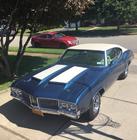
 1970 Olds Rallye 350




 Joe I think i found the last port?
 Hi Kenneth

 Joe Question..