When you click on links to various merchants on this site and make a purchase, this can result in this site earning a commission. Affiliate programs and affiliations include, but are not limited to, the eBay Partner Network.
Wow that's nasty I can't offer any advice except there was probably some existing damage dented or rusted where it broke. I've broken 2 DSs in 2 trucks they twisted apart where rust had started at a sleeve on the DS. Once I had no dmg, once I poked a hole in my gas tank but that's it
...there was probably some existing damage dented or rusted where it broke...
A T-400 is gentle on the drive-train compared to a 4-speed, so I agree with the Ranger.
At a minimum I would check the rear axle pinion shaft and T-400 output shaft for concentricity. If they check out, I wouldn't be concerned about internal damage.
If the engine overreved on driveshaft breakage, I would look for any signs of damage such as uneven idle, different sound from the exhaust, or increased blowby.
Weakest link in the chain. Most times this happens after slicks are used for the first time. Also why race tracks require drive shaft safety loops. I did this with a 71 442 convertible years ago and beat the new exhaust system to pieces. ~BOB
I was accelerating through a quarter mile stretch, the auto trans shifted into 3rd at about 70-80 mph, then kept climbing till about 5k rpm, then BAM, driveshaft parts scattered everywhere. So, the car was in motion, which leads me to believe it was a balance/rust/dent issue with the driveshaft spinning at 1:1 (5k).
Last edited by pmathews; Oct 3, 2016 at 10:30 AM.
Reason: for clarity
Call Denny and have him whittle you an aluminum shaft. Absolute Perfection! I just installed one. Those two piece automatic shafts should'ev been outlawed...junk. Thats why the 4 speeds didnt get them. I twisted the **** out of mine(out of phased) but it didnt grenade like that.
Nice work by the way! Hope nuthin else was hurt?
Check the back of the trans and rear end pinion for damage. If no visible damage is present, throw another drive shaft in it and hopefully no bad vibes.
I remember back in the 80s seeing a raggedy, primered 75 Trans Am on the side of I-635 in Dallas with a mangled drive shaft sticking out through the shattered back glass. Looked like it had come up right between the lower back seat cushions and through the window.
Been there & done that, first time @ track stock driveshaft let go in the speed trap. Luckily it spit out the back in pieces like yours. Had to run to the time slip shack & stop cars from running down track until we could get it all Picked up. Broke trans case, wrecked exhaust, tore up floor above tail shaft. My new Denny's drive shaft arrived Monday (after that Friday) after being on order for several weeks as they were backed up, go figure!
The 3.90's greatly increase driveshaft speed & that was undoubtedly the straw that broke your camel's back.
The 3.90's greatly increase driveshaft speed & that was undoubtedly the straw that broke your camel's back.
Ugh, THAT makes me nervous. While I'm not making boatloads of torque under the hood, my CK-built trans shows no mercy on the driveline when it shifts. I'm thinking a 1-piece aluminum driveshaft is going to be cheap insurance in the not too distant future.
Ugh, THAT makes me nervous. While I'm not making boatloads of torque under the hood, my CK-built trans shows no mercy on the driveline when it shifts. I'm thinking a 1-piece aluminum driveshaft is going to be cheap insurance in the not too distant future.
You DO realize that steel is three times stiffer than aluminum, right? Depending on the grade of steel and the grade of aluminum, steel can also be much stronger. The real problem is welding aluminum at the yokes. Assuming they are using heat-treated aluminum for strength, the heat treat is lost in the heat-effected zone around the welds. Unless the whole driveshaft is annealed and re-heat treated after welding, the welds will be weak links.
Video of the yoke in the transmission, looks kind of loose, is this normal?
Yes. The yoke rides in a bushing in the tailhousing to stabilize the output shaft. Without the yoke in place, the trans output shaft has all kinds of motion like that. I'd be more worried that the bushing was damaged, though it is pretty easy to replace.
Normal play. The Ebrake cable is routed wrong. Not the resident 67 expert. Pull the tail shaft housing for inspection. Definitely need another pinion yoke.
You DO realize that steel is three times stiffer than aluminum, right? Depending on the grade of steel and the grade of aluminum, steel can also be much stronger. The real problem is welding aluminum at the yokes. Assuming they are using heat-treated aluminum for strength, the heat treat is lost in the heat-effected zone around the welds. Unless the whole driveshaft is annealed and re-heat treated after welding, the welds will be weak links.
Yes. But are you saying that I'm safer w/ my 50 year old two-piece steel driveshaft, that now gets pounded harder every shift than if it were behind a 4-speed, spinning in front of a 3.90 rear that will (hopefully) be trapping at nearly 110 MPH once I rebuild my engine........than with a "properly" welded / built / heat-treated / balanced aluminum shaft?
I'm leaning towards aluminum to help reduce rotational inertia, but if going there increases the risk of breakage compared to my 50-y/o steel shaft, I'll need to rethink my plans. But I'm not planning on welding up my own aluminum DS either.
Give Denny a call and ask these questions. Thats all he does is driveshafts. He can make you what ever you want...steel, aluminum etc...here it directly from the horses mouth. Hes for real no BS. His aluminum shafts are good for something like 5-600hp.
Thanks guys, will pull the tailshaft housing and assess the play between the yoke and bushing.
With regards to replacing that pinion yoke, can I just unbolt and swap, or will it require a gear setup, crush bearing, etc...?
I'm not an expert (although I did rebuild my own type-O) but I'd think that once you unbolt that pinion nut, the pinion bearing preload will be upset and you'll at least need a new crush sleeve to (properly) re-establish it. Your gear setup should still be OK unless the pig got bent (doubtful), but I think it'd be worth re-checking it while you have it out to put in that new crush sleeve.
Advice: Buy 2 crush sleeves. If you've not done this before, its real easy to over-crush it on the first try.
Last edited by JohnnyBs68S; Oct 4, 2016 at 09:24 AM.
The shadetree approach when replacing the pinion seal is to mark the nut and shaft, count the turns to pull it off, and reinstall at the same place just a slight bit tighter - 1/16 of a turn or so. With used bearings in a setup that has had some time on it this works pretty well. For yoke replacement the critical measurements would have to be identical which is, uh, rare, or accurately accounted for which is not easy to measure in a garage.
One could very carefully get the nut to zero lash, then just a slight bit tighter. It's a big pinch nut, so that's not easy. Depending on what you want to do you could easily get years of service out of it like this.
Or, for peace of mind, have a shop do a proper setup.
I used Driveshaft Specialist of Texas - good work and good prices. At your power level the shaft material doesn't matter too much. Max rotational speed does, depending on your anticipated max speed. Aluminum usually needs to be 1/2" to 1" wider than steel for the same rotational stability, which can start to cause floor clearance problems if you go crazy. But, they are super light and very pretty. I have one.
But I'm not planning on welding up my own aluminum DS either.
Doesn't matter who is welding aluminum, the problem is the same. Any heat treated alumium alloy looses heat treat when welded. You either account for the reduced strength in the design or you anneal the entire welded part and re-heat treat. I've done a lot of aluminum weldments for aerospace applications.
By the way, my point was NOT to keep your half-century-old driveshaft but to intelligently trade new steel vs. new aluminum.
What people don't understand is that when parts are properly designed, with proper selection of materials, strength-to-weight and stiffness-to-weight are about the same for steel and aluminum. Finished weight of the part will be about the same.
I would also do some research on proper pinion angle for your car. It seems like your car is raised, which could effect the overall driveline geometry. Better to be safe. I also remember seeing a quick reference chart by the Dana corp. relating driveshaft diameter vs length and rpm. High performance cars required larger diameter shafts to avoid driveshaft whip, it was a long time ago, that's all I remember. Good luck
Check the riding position of the driveshaft. I mean support the car by the suspension all the way around and then check to make sure the driveline has the proper amount of slip to the yoke.
It does look like the ujoints failed in the front yoke picture.
Just my two cents.
I am lucky have a machine shop locally that builds driveshafts and balances them. it is actually pretty cheap to have one built from scratch. About $150.





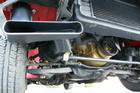
 It was dark when I got it home last night, so I couldn't see much, but I will crawl under it this evening.