


HP Ratings....pre 1971 vs. 1971 and up??

Thread Starter
Registered User
Joined: Sep 2011
Posts: 378
From: Near Cleveland, OH
HP Ratings....pre 1971 vs. 1971 and up??
I have always found the HP ratings for the 68-72 Cutlass 350's to be confusing. For example, my 72 supreme was officially rated at 180 HP with a 4bbl and dual exhaust. Can this be correct? That's a really small number compared to the 1970, for example, which IIRC is over 300. Were there actually that many changes made or was it just how they rated the HP for insurance purposes?
Now that I've sold my '72, I'm wondering if it's worth sticking with the '68-'70 cars instead of the '68-'72 range that I've been looking at.
Is there much data out there on the actual HP numbers for the stock 350's?
Thanks
Now that I've sold my '72, I'm wondering if it's worth sticking with the '68-'70 cars instead of the '68-'72 range that I've been looking at.
Is there much data out there on the actual HP numbers for the stock 350's?
Thanks

Registered User
Joined: Jun 2009
Posts: 15,188
From: southeastern Michigan
Around that time, the auto manufacturers went to (or were required to) post "net" horsepower ratings instead of "gross" horsepower. I don't know all the ins and outs and all the correct terms, but originally they would report the hp when there was no load on the engine. Net horsepower means what's left to actually move the car after the power drain for running the various components (power steering, alternator, A/C, etc.) was subtracted.
Like I said, I may not have this all completely correct, but it was something like this, and I'm sure others will have a better answer.
Like I said, I may not have this all completely correct, but it was something like this, and I'm sure others will have a better answer.
1974 DELTA 88
Joined: Jun 2011
Posts: 569
From: Yavapai County, Arizona

Registered User
Joined: May 2009
Posts: 2,212
From: USA
1971 and earlier = GROSS horsepower rated.
1972 and later = NET horsepower rated.
So yes, anything before 1972 had a rating that's weaker by today's standards.
So for example a 1964 GTO which was the first car of the Muscle Car genre had
claims of 325hp. The reality was after 1972 that 325hp became more like 280hp.
GROSS HP
Engines were rated by what a stripped engine put out in perfect conditions on
a stand with no accessories. This is also how today's crate engines are rated.
Very misleading too, buyers get upset when they don't dyno out that high after install.
NET HP
was rated by what an engine put out in the engine bay fully accessorized.
That's why the HP ratings dropped in 1972. Then the emissions choked them after.
1972 and later = NET horsepower rated.
So yes, anything before 1972 had a rating that's weaker by today's standards.
So for example a 1964 GTO which was the first car of the Muscle Car genre had
claims of 325hp. The reality was after 1972 that 325hp became more like 280hp.
GROSS HP
Engines were rated by what a stripped engine put out in perfect conditions on
a stand with no accessories. This is also how today's crate engines are rated.
Very misleading too, buyers get upset when they don't dyno out that high after install.
NET HP
was rated by what an engine put out in the engine bay fully accessorized.
That's why the HP ratings dropped in 1972. Then the emissions choked them after.
Last edited by Aceshigh; Oct 26, 2011 at 08:45 PM.
1974 DELTA 88
Joined: Jun 2011
Posts: 569
From: Yavapai County, Arizona
Thread Starter
Registered User
Joined: Sep 2011
Posts: 378
From: Near Cleveland, OH
Weren't there at least some real changes made though on the 71 and 72 vs. the 68, 69 and 70, for example? The valve seats and maybe lower compression? Or will a 1971 350ci dyno the same as a 1970 350ci (with all other factors equal) in the real world?
Thread Starter
Registered User
Joined: Sep 2011
Posts: 378
From: Near Cleveland, OH

GM Enthusiast
Joined: Jan 2007
Posts: 3,982
From: Long Island, New York
The compression was lowered in 71 Olds engines, a year before Chevrolet did it to theirs. That, and the change to net hp ratings from gross, and the new emissions equipment (egr valve, catalytic converter, smog pump) really made the 70's engines look and feel anemic compared to their 60's counterparts.
Thread Starter
Registered User
Joined: Sep 2011
Posts: 378
From: Near Cleveland, OH
I drove a beautiful '71 Cutlass Supreme today. It's a very nice car and ran great but wow was it a dog! Seemed even slower than my '72, so that was pretty disappointing. Didn't have the passing gear working properly so that didn't help.
I can't help but wonder what a 1970 would feel like....I remember my friend's '70 being way faster than my '72 but I'm not sure if his engine was stock or not. Anybody driven both recently?
I can't help but wonder what a 1970 would feel like....I remember my friend's '70 being way faster than my '72 but I'm not sure if his engine was stock or not. Anybody driven both recently?
GM Enthusiast
Joined: Jan 2007
Posts: 3,982
From: Long Island, New York
The car you drove probably needs to be checked over, and yes the kickdown cable would make a big difference in driveability.
My 71 is all stock, 350, 4bbl. I rejetted/changed metering rods in the carb until I came up with the right combo for today's gas and put dual exhaust on it with flowmasters. It is not a race car and I'm not going to beat a new Camaro, but I can easily do a 20" burnout with a 2.56 rear and it pulls strong throughout the rpm range.
My 71 is all stock, 350, 4bbl. I rejetted/changed metering rods in the carb until I came up with the right combo for today's gas and put dual exhaust on it with flowmasters. It is not a race car and I'm not going to beat a new Camaro, but I can easily do a 20" burnout with a 2.56 rear and it pulls strong throughout the rpm range.
Registered User
Joined: Nov 2006
Posts: 1,790
From: McMurray, PA
Terry
Thread Starter
Registered User
Joined: Sep 2011
Posts: 378
From: Near Cleveland, OH
I guess if I get this '71 I could hop it up a little bit with mild mods but maybe I should wait for the right 68-70 car.....unless a really good deal comes along.
I just looked at a 71 442 today and it has a '76 455 in it. The car looks nice but I couldn't drive it as it has no exhaust. I would guess the 455, even though newer, would have more power than a 71 or 72 350 right? I've never owned a big block....just 350's and 260's (and a 4 door 6-cylinder but I won't count that!)
I just looked at a 71 442 today and it has a '76 455 in it. The car looks nice but I couldn't drive it as it has no exhaust. I would guess the 455, even though newer, would have more power than a 71 or 72 350 right? I've never owned a big block....just 350's and 260's (and a 4 door 6-cylinder but I won't count that!)

Registered User
Joined: Feb 2011
Posts: 1,591
From: Denmark
As far as I could read on the Olds FAQ, they dished the pistons deeper in '71 and until '73 or so, where they made larger chambers in the heads instead. This would mean that if you take heads off a '72 or older 455 and put them on your '76 455, you'll have high-compression pistons and small chambers, giving you good compression. I don't know if this is only true for 350 CIDs or for both 350 CIDs AND 455 CIDs.
Originally Posted by Olds FAQ
From what I've seen, it appears that in '71 (when they needed to drop all of the compressions in GM cars - 10.5 to 8.5) that their first method of doing it was to dish the pistons more. In 1973 they increased the chamber sizes on the heads and went back to piston comparable to 1970 and prior.
Thread Starter
Registered User
Joined: Sep 2011
Posts: 378
From: Near Cleveland, OH
That's interesting stuff about the heads....sounds like it could work.
I'm leaning toward the '71 Supreme with the stock 350. It's a really nice car and I could always throw on a few engine upgrades if I wanted to. I'm sure there are lots of good articles on here about that.
I guess I had just hoped that the '71 would seem a little faster than my '72 but it sure doesn't. The engine is probably identical to the one I had in my '72.
I'm leaning toward the '71 Supreme with the stock 350. It's a really nice car and I could always throw on a few engine upgrades if I wanted to. I'm sure there are lots of good articles on here about that.
I guess I had just hoped that the '71 would seem a little faster than my '72 but it sure doesn't. The engine is probably identical to the one I had in my '72.
Registered User
Joined: Feb 2011
Posts: 1,591
From: Denmark
Apart from the '71 having 7 heads instead of 7a heads, they should be practically identical. Putting high compression pistons it in would get you a long way towards that pre-'71 performance, it would seen. I'm not sure, though.
Seasoned beater pilot.
Joined: Jan 2007
Posts: 5,468
From: Chicago
If you don't plan to put new pistons in,
1971 and 1972 350 were the worst. You would be better off getting any other year in my opinion.
71 & 72 are the most popular cars on here that people want to "fix up" and they are the biggest dogs of them all as far as engine piston compression goes.
1971 and 1972 350 were the worst. You would be better off getting any other year in my opinion.
71 & 72 are the most popular cars on here that people want to "fix up" and they are the biggest dogs of them all as far as engine piston compression goes.
Registered User
Joined: Feb 2010
Posts: 1,587
From: West Michigan
Any '71 or '72 Olds 350 that behaves like a dog -- even if a 2 bbl -- has got something wrong with it. That's not how they came from the factory.
I drove a '72 2-bbl 350 Cutlass S for years. Even with its highway gears, it was a lot of fun to drive, would burn rubber until you lifted, and would never be called a dog.
I drove a '72 2-bbl 350 Cutlass S for years. Even with its highway gears, it was a lot of fun to drive, would burn rubber until you lifted, and would never be called a dog.

Where were you in '72?
Joined: Nov 2009
Posts: 262
From: Ottawa, Ont
I installed flat tops and opened up my Qjet on my '72 350 and now the only big issue i'm having now is getting all the new found torque to the ground. I swear when I hit the pedal this thing sublimates tires.

Thread Starter
Registered User
Joined: Sep 2011
Posts: 378
From: Near Cleveland, OH
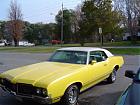
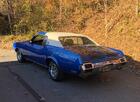
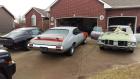
The engine in the '71 ran perfectly. Really smooth, no smoke or noises, not even a lifter tick. It just barely moved when it was floored. Here are a few pictures I took with my cell phone....this thing isn't a 260 in disguise or something is it?
Registered User
Joined: Nov 2010
Posts: 1,070
From: Wichita, Ks
I'd heard about 4% increase in horsepower for 1 point of compression increase. So I would not expect a lot of horsepower. I think the exhaust is the best place to gain some horsepower unless you are planning to rebuild the motor.
And I'll agree my 72 350 2bbl still impresses me after driving around a 200hp v6.
And I'll agree my 72 350 2bbl still impresses me after driving around a 200hp v6.
Where were you in '72?
Joined: Nov 2009
Posts: 262
From: Ottawa, Ont
It's all about the combination, increased compression, more fuel, more air, more exhaust. I took a stock '72 2bbl 350 and applied the above principals and i'm very impressed with the results, a much more responsive engine...stock non-posi rear end with a Transgo mild shift kit. I don't know what the dyno results are in terms of percentages...my butt dyno tells me this was well worth the effort.
Where were you in '72?
Joined: Nov 2009
Posts: 262
From: Ottawa, Ont
If I were state side I would scoop that one up real quick, looks immaculate, suspect the rest of the car is the same...what I would do is pull that engine and set it up right, although a good tune up and carb kit might be an option.
Thread Starter
Registered User
Joined: Sep 2011
Posts: 378
From: Near Cleveland, OH
It truly is a very nice car. The way it rode and drove was awesome too....so solid it was surprising. So many times I look at cars in person and they're not nearly as nice as they're made out to be, but this one is. I'm still thinking long and hard about it....
Thread Starter
Registered User
Joined: Sep 2011
Posts: 378
From: Near Cleveland, OH
OK, here's another HP question. There's another '71 Supreme listed locally here that claims to have a 275 HP 350, factory option code L74. Didn't make that much HP in 1971, right? I think the L74 in the earlier years had higher HP but it was just the std 350 4 barrel for '71, wasn't it?
L74 Engine, V-8 4BC (330)
L74 High Compression V-8 Engine (1966)
L74 High Compression V-8 Engine 4-Bbl. (1967)
L74 High Compression 350 Cu. In. V-8 4Bbl. (1968-1970)
L74 350 Cu. In. V-8 4 Bbl. (1971)
L74 455 Cu. In. 4-Bbl. (B Body) (1972)
L74 Engine, V-8 4BC (330)
L74 High Compression V-8 Engine (1966)
L74 High Compression V-8 Engine 4-Bbl. (1967)
L74 High Compression 350 Cu. In. V-8 4Bbl. (1968-1970)
L74 350 Cu. In. V-8 4 Bbl. (1971)
L74 455 Cu. In. 4-Bbl. (B Body) (1972)

Registered User
Joined: Nov 2006
Posts: 1,790
From: McMurray, PA
OK, here's another HP question. There's another '71 Supreme listed locally here that claims to have a 275 HP 350, factory option code L74. Didn't make that much HP in 1971, right? I think the L74 in the earlier years had higher HP but it was just the std 350 4 barrel for '71, wasn't it?
Thread Starter
Registered User
Joined: Sep 2011
Posts: 378
From: Near Cleveland, OH
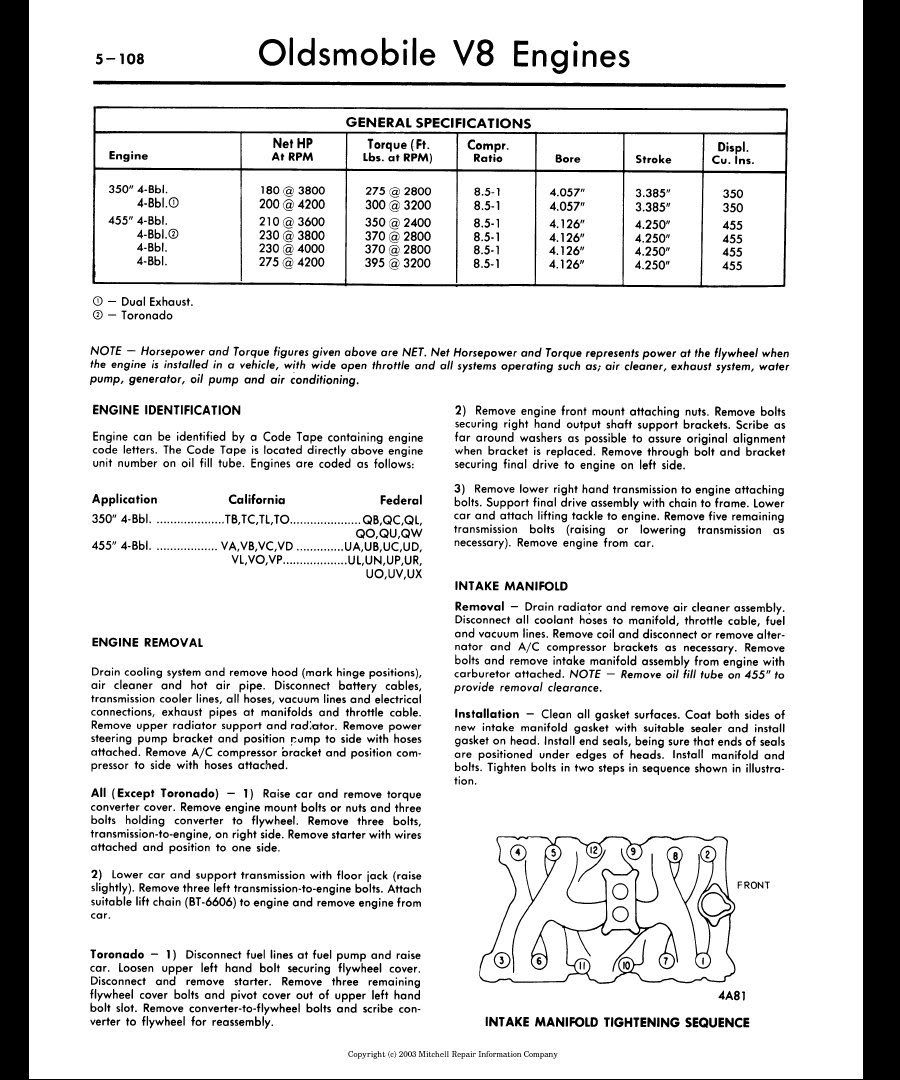
[QUOTE=AZ455;338990]Here are the HP/Torque ratings as well as changes in compression ratio from 1968 through 1974 for Olds V8s.
QUOTE]
That's great info...comp ratios and everything. Really explains a lot, thanks for sharing.
QUOTE]
That's great info...comp ratios and everything. Really explains a lot, thanks for sharing.
1974 DELTA 88
Joined: Jun 2011
Posts: 569
From: Yavapai County, Arizona
Kind of interesting to see the differences. The 1974 chart is a little strange, as it shows HP and torque at several different RPM.
On the page that shows 68 through 73 you will also notice that it is only NET horsepower 1972 and later, and from there the numbers take a huge dive. So I would imagine anything after 1971 would have comparable power to what the 1971 specs are using the gross hp rating system, since in 1971 the compression ratio was already 8.5-1. Then there is emissions to take into consideration. . .
Last edited by AZ455; Nov 8, 2011 at 01:48 PM.
Registered User
Joined: May 2009
Posts: 2,212
From: USA
I put my 1970's rebuilt 350 on a dyno and it spit out ~300hp at the crank and ~425ft lbs.
That's the ONLY way to really know what you have, to put it on a dyno.
Whatever your choice is, you need to get the best flowing head you can for it.
Mid to late 70's isn't going to be the best options at all.
That's where you make your power. Olds heads need ALOT of work in many cases.
That's the ONLY way to really know what you have, to put it on a dyno.
Whatever your choice is, you need to get the best flowing head you can for it.
Mid to late 70's isn't going to be the best options at all.
That's where you make your power. Olds heads need ALOT of work in many cases.
Last edited by Aceshigh; Nov 8, 2011 at 11:04 PM.

Registered User
Joined: Oct 2010
Posts: 285
From: Maryland
I don't know about Gross vs Net HP, but I do know about high compression vs low compression. 71 was the beginning of the demise of the muscle car and the EPA had alot to do with it. Why isn't there a 71 W31? Olds tried but it couldn't pass emissions so it died. Beginning in 71 the emissions were measured by emissions emitted / volume of gas consumed. So the wigs in Detroit decided it was easier to consume more gas so they could emit more emissions. They retarded the timing and lowered the compression, thus consuming more fuel and past emissions. Detroit figured that the consumer didn't have a choice except to buy what it offered. Then the 73 oil embargo hit and muscle cars couldn't be given away. In 74-75 my best friend sold his k-code 65 Mustang convertible in great shape for $200. It was the only offer he had. This death spiral continued for over a decade giving the Jap cars a huge boost in sales and market share until Detroit decided to engineer efficient cars which again produced performance. Thank God!
As to manufacture rated HP, it was all marketing. The 1969 Z28 Camaro is rated @ 290 hp. GM also had a ceiling of 400 cid on all mid sized cars except the Corvette until 1970, but ingenius dealers figured out how to beat this using COPO (Central Office Production Order), hence the Yenko and Baldwin-Motion Camaros. COPO was designed to produce green vans for the phone company.
So, 1970 was the first year of the over 400 cid and the last year of high compression. It was a very good year!!!!!!!!!
So to answer your question is there a difference between 1968-1970 and 1971-72?
Hell yea!!!!!!
As to manufacture rated HP, it was all marketing. The 1969 Z28 Camaro is rated @ 290 hp. GM also had a ceiling of 400 cid on all mid sized cars except the Corvette until 1970, but ingenius dealers figured out how to beat this using COPO (Central Office Production Order), hence the Yenko and Baldwin-Motion Camaros. COPO was designed to produce green vans for the phone company.
So, 1970 was the first year of the over 400 cid and the last year of high compression. It was a very good year!!!!!!!!!
So to answer your question is there a difference between 1968-1970 and 1971-72?
Hell yea!!!!!!
Connoisseur d'Junque
Joined: Sep 2010
Posts: 21,183
From: The Hudson Valley
From "Numerical Prediction of NOX in the Exhaust of a Compression Ignition Engine,"
by A. A. Pawar, and R. R. Kulkarni, in World Academy of Science, Engineering and Technology, 43, 2008:
"... NOx emissions are related to start of combustion timing and the energy released in premixed burning. Earlier start of combustion causes higher cylinder pressure and higher combustion temperature, which cause higher NOx emissions. More energy released in premixed combustion causes more rapid cylinder pressure rise and higher combustion temperatures that consequently elevate NOx emissions."
This article refers to diesels, but the formation of NOx is the same in both.
- Eric


