


Can't bleed rear brakes!!!

Thread Starter
Registered User
Joined: Nov 2011
Posts: 44
From: Sudbury, Ontario
Can't bleed rear brakes!!!
I blew the rear brake line on my 72 Cutlass the other day.
Thankfully the car was in my garage up on jack stands at the time. I made up a new line that goes from the (proportioning valve?) to the rear rubber line. I refilled the rear bowl on the master cylinder and tried to bleed the rear brakes. I'm not getting any fluid to the rear brakes. The brakes worked fine before the line blew. I have power drums all the way around. Do I have to push/ hold a button or something on the (proportioning valve?) to get it to bleed properly. If so, can someone post a picture of where it is on the valve?
Thankfully the car was in my garage up on jack stands at the time. I made up a new line that goes from the (proportioning valve?) to the rear rubber line. I refilled the rear bowl on the master cylinder and tried to bleed the rear brakes. I'm not getting any fluid to the rear brakes. The brakes worked fine before the line blew. I have power drums all the way around. Do I have to push/ hold a button or something on the (proportioning valve?) to get it to bleed properly. If so, can someone post a picture of where it is on the valve?
Proud Viet Nam Veteran
Joined: Dec 2006
Posts: 10,817
From: Rowlett, TX
With 4 wheel drum brakes, that is not a proportioning valve but a distribution block. These brakes are a pain to bleed. You have probably emptied the rear of the master cylinder completely. It may be necessary to bench bleed the master cylinder just like you would a new one. That is what I would do first. I believe the button is only to make the brake light go off. It has been so long since I have done these, I may be wrong. Others may have some better ideas.
Thread Starter
Registered User
Joined: Nov 2011
Posts: 44
From: Sudbury, Ontario
First I tried leaving a bleeder open for a day hoping it would gravity bleed but nothing happened. Now I've got my wife pumping and holding the pedal while I open and close the bleeder at the right rear wheel. I've bled lots of brakes before so bleeding is not new to me. I cracked the fitting at the distribution block and got a little bit of fluid but i didn't completely disconnect the line. Tomorrow, I'll try cracking the line at the master cylinder to see if I'm getting anything there. Or..... what would happen if I could somehow "prop" the brake pedal down. Would that open the circuit between the master cylinder bowl and the brake line and possibly start to gravity bleed?

GM Enthusiast
Joined: Jan 2007
Posts: 3,982
From: Long Island, New York
I would bench bleed the m/c then use a vacuum bleeder 1st on the right rear, then the left rear, right front and then left front. Don't let the m/c run out of brake fluid as your doing this. A vacuum bleeder would make this job a lot easier and are pretty inexpensive.
Administrator
Joined: Oct 2009
Posts: 42,496
From: Poteau, Ok
I believe as said above your master cylinder needs a bleeding first and the distribution block theory is also a probability. It also could be one of the ends on the new line you fabricated, hopefully you did not put any type of tape or thread sealer on there.

Old(s) Fart
Joined: Mar 2007
Posts: 50,802
From: Northern VA
Let's back up.
When you say you aren't getting fluid to the rear brakes, does that mean you aren't getting anything out of the bleeder screws, or nothing from the hard line INTO the wheel cylinders?
If the problem is simply nothing out of the bleeders, have you removed the bleeders to ensure they are not plugged with rust? If that's not the problem, get a piece of copper wire and push it into the hole in the wheel cylinder where the bleeder goes. We had this same problem on a friend's Supreme and it turned out that there was rust inside the wheel cylinder that was blocking the outlet port to the bleeder. Once the rust was broken free, we had no problems bleeding the brakes. Of course, the fact that there was that much rust inside the wheel cylinder didn't bode well for that cylinder.
If your bleeders are not plugged, it's possible you've pushed the differential pressure switch piston all the way to one side inside the distribution block, causing it to shut off fluid flow to the back brakes. This is common when you blow a brake line and are pressing hard on the pedal. If there's any rust or sludge in the system, it can cause the piston to stick. Is the wire hooked up to the distribution block terminal, and is the BRAKE light illuminated? If this is the problem, you'll need to recenter the piston. You can usually do this by opening one of the FRONT bleeder screws and lightly pressing the pedal to the floor. The higher pressure in the rear brakes will hopefully recenter the piston.
When you say you aren't getting fluid to the rear brakes, does that mean you aren't getting anything out of the bleeder screws, or nothing from the hard line INTO the wheel cylinders?
If the problem is simply nothing out of the bleeders, have you removed the bleeders to ensure they are not plugged with rust? If that's not the problem, get a piece of copper wire and push it into the hole in the wheel cylinder where the bleeder goes. We had this same problem on a friend's Supreme and it turned out that there was rust inside the wheel cylinder that was blocking the outlet port to the bleeder. Once the rust was broken free, we had no problems bleeding the brakes. Of course, the fact that there was that much rust inside the wheel cylinder didn't bode well for that cylinder.
If your bleeders are not plugged, it's possible you've pushed the differential pressure switch piston all the way to one side inside the distribution block, causing it to shut off fluid flow to the back brakes. This is common when you blow a brake line and are pressing hard on the pedal. If there's any rust or sludge in the system, it can cause the piston to stick. Is the wire hooked up to the distribution block terminal, and is the BRAKE light illuminated? If this is the problem, you'll need to recenter the piston. You can usually do this by opening one of the FRONT bleeder screws and lightly pressing the pedal to the floor. The higher pressure in the rear brakes will hopefully recenter the piston.
Registered User
Joined: Jul 2011
Posts: 93
From: Ajax, Ontario
X2 what Joe said. I've ran into this problem myself. After bench bleeding you can hook up a continuity tester that has an alarm to it (connect one end to brake switch and the other to ground) and with one bleeder on the front cracked step on the brake pedal. The sound from the tester will stop when the switch is reset (piston is centered). Then you can go and bleed the system as normal.
Thread Starter
Registered User
Joined: Nov 2011
Posts: 44
From: Sudbury, Ontario
Thanks for the replies so far. Today I went out to the garage after work and found that:
1) I believe the piston in the distribution block is sliding back and forth like it should, because the brake warning light goes on and off as I push and release the brake pedal. That tells me the piston is moving back to the centre position when I let go of the pedal which turns the warning light off, correct?
2) I cracked open the rear line at the M/C to check for fluid there as my wife pumped the pedal. I got hardly anything. So that tells me I need to bench bleed the M/C before I go any further. I'm going to make up a line to go from the rear M/C outlet back into the rear bowl and try to bench bleed it without removing the M/C from the car. I just need to find an extra brake line fitting to match up with the outlet of the M/C.
1) I believe the piston in the distribution block is sliding back and forth like it should, because the brake warning light goes on and off as I push and release the brake pedal. That tells me the piston is moving back to the centre position when I let go of the pedal which turns the warning light off, correct?
2) I cracked open the rear line at the M/C to check for fluid there as my wife pumped the pedal. I got hardly anything. So that tells me I need to bench bleed the M/C before I go any further. I'm going to make up a line to go from the rear M/C outlet back into the rear bowl and try to bench bleed it without removing the M/C from the car. I just need to find an extra brake line fitting to match up with the outlet of the M/C.
Old(s) Fart
Joined: Mar 2007
Posts: 50,802
From: Northern VA
Actually, now that I have my pneumatic vacuum bleeder, this problem no longer exists. The vacuum bleeder can suck the air out all the way to the M/C. No more bench bleeding for me.
Registered User
Joined: Jul 2011
Posts: 93
From: Ajax, Ontario
I put a new master on the 73 and it has the internal bleeders. Pain in the you know what. Front would bleed great, back neededthe bubbles punctured every time. I wish it had the old style with tubes running back to the master for the bench bleed. I need a power bleeder.
Connoisseur d'Junque
Joined: Sep 2010
Posts: 21,183
From: The Hudson Valley
Remember that the M/C needs to be level during bench bleeding, to prevent the retention of an air pocket.
If your master sits level, then it's no problem to do it on the car - I've done it the way Joe suggests many times, and it's worked great.
If your master sits on an angle, though, you're either going to have to park on a hill, or remove it to bench bleed.
- Eric
If your master sits level, then it's no problem to do it on the car - I've done it the way Joe suggests many times, and it's worked great.
If your master sits on an angle, though, you're either going to have to park on a hill, or remove it to bench bleed.
- Eric
Thread Starter
Registered User
Joined: Nov 2011
Posts: 44
From: Sudbury, Ontario
I tried bench bleeding the M/C in the car with my son pumping the pedal for me. I used a short piece of clear hose from the outlet back into the bowl. I watched the line while he pumped. At first there was lots of air bubbles, but he kept pumping and soon there was only brake fluid moving back and forth in the hose, no bubbles. I yanked the hose out and hooked up the brake line quickly. Then I cracked the lines down at the distribution block and got him to keep pumping so I could watch for fluid , but none came. What did I do wrong?
I know i said I've bled lots of brakes before, I've even changed M/C's before so this should not be this difficult for me!
I know i said I've bled lots of brakes before, I've even changed M/C's before so this should not be this difficult for me!
Administrator
Joined: Oct 2009
Posts: 42,496
From: Poteau, Ok
The problem is that with the open line all your doing is moving air back into your system like a syringe. You have to go to the end and do a proper bleed. Have your son pump the brakes untill there is some pedal hold it, while you release the pressure at the wheel cylinder bleeder valve. The pedal will go to the floor and he needs to hold it there untill you close the valve. Then he needs to pump it up until there is pedal and repeat untill there is no more air in the line. Do not let the M/C empty so add fluid untill the job is finished.
Last edited by oldcutlass; Mar 24, 2013 at 07:08 PM.
Registered User
Joined: Jul 2011
Posts: 93
From: Ajax, Ontario
When I put my master on following the bench bleed, I filled the line to the rear cylinders using a clear hose and syringe connected to the rear line to the combination/proportional valve. Takes a bit but at least i knew the line was reasonably full prior to connection. When the line is full you connect to the master and bleed it at that fitting first to get the air out of that connection followed by the normal gravity bleed to the rears before pumping. If the rear line has air at some point some may get back to the master and you'll have to do it all over.
Thread Starter
Registered User
Joined: Nov 2011
Posts: 44
From: Sudbury, Ontario
I'm on my third helper now, and still haven't got anywhere. My dad is helping me today. We tried bench bleeding the M/C on the car again with a clear hose from the rear outlet back into the reservoir. Dad noticed that every time the pedal was released the brake fluid would get pulled back up the hose to the outlet instead of just dumping back into the M/C and pulling fresh fluid from the M/C. So, the fluid is not getting pushed down the brake lines, it just gets sucked back to the M/C everytime the pedal is released. I agree that it shouldn't be doing this, it should pull the fluid from the reservoir to fill the line, not pull the fluid back up the line. Also, everytime we pump the pedal and crack the line at the M/C we get air. Dad thinks there's a problem with the M/C but it worked fine before the brake line blew. What else can I check/ do?
Administrator
Joined: Oct 2009
Posts: 42,496
From: Poteau, Ok
When the pedal is pushed the bleeder needs to be open until the pedal is floored. Once floored it needs to be held there, and the bleeder closed. Once the bleeder is closed, then the helper pumps the brake pedal until there is some resistance and then holds it there with just enough pressure to push it to the floor when the the bleeder is opened. Then the helper holds the pedal to the floor until you close the bleeder again. Repeat until there are no bubbles, and then do the same thing at the wheel cylinders.
Thread Starter
Registered User
Joined: Nov 2011
Posts: 44
From: Sudbury, Ontario
"When the pedal is pushed the bleeder needs to be open until the pedal is floored. Once floored it needs to be held there, and the bleeder closed. Once the bleeder is closed, then the helper pumps the brake pedal until there is some resistance and then holds it there with just enough pressure to push it to the floor when the the bleeder is opened."
That is exactly what we are doing. No matter how many times we pump the pedal we NEVER get any pressure building up.
That is exactly what we are doing. No matter how many times we pump the pedal we NEVER get any pressure building up.
Registered User
Joined: Jul 2011
Posts: 93
From: Ajax, Ontario
Still sounds like an air problem, seeing as the line and master were completely drained. It takes a bit to get all the air out of the rear chamber. With the master cylinder mounted in the car the air will go to the top end of the cylinder and will not be driven out. Definitely a pain but it may be worthwhile taking the master off. Once level and on the bench you can see better and the air should come out. If you know the prop valve is reset you can fill the line to the rears at least that way you'll know it's more than likely full. The rear line will take ~1/3 litre give or take. As with anything this will take time, so don't be in a hurry. When I bench bled my master (new style Dorman replacement with self bleeders) it took about 40 minutes before I got all the air out. Once the lines and master are full, same process as usual. I know what it feels like, spent a number a days working in Brake component hell.
morgan
Joined: Mar 2011
Posts: 1,925
From: CT
Just keep with it as frustrating as it is laws of psysics still apply, tighten all fittings pump brakes and double check for fluid loss if fluid remains the same bench the master cyl. Like the last poster mentions it sometimes take a while to disperse all the air
Old(s) Fart
Joined: Mar 2007
Posts: 50,802
From: Northern VA
"When the pedal is pushed the bleeder needs to be open until the pedal is floored. Once floored it needs to be held there, and the bleeder closed. Once the bleeder is closed, then the helper pumps the brake pedal until there is some resistance and then holds it there with just enough pressure to push it to the floor when the the bleeder is opened."
That is exactly what we are doing. No matter how many times we pump the pedal we NEVER get any pressure building up.
That is exactly what we are doing. No matter how many times we pump the pedal we NEVER get any pressure building up.
Just so we're all clear, you won't feel any resistance while a bleeder screw is open or a brake line at the M/C is loose. Are you saying that once you've bled the system and tightened everything back up, you still get no pedal pressure? I seriously doubt there is still air in the system, so start thinking about a defective M/C.
Before you do that, however, I'm still fuzzy on one thing. Did you attempt to bleed the M/C the way I suggested in the car - simply cracking the line fitting loose, pressing on the pedal, tightening, THEN releasing the pedal? The M/C MUST suck fluid back in the port when you release the pedal under normal use - if it didn't, your brakes would lock up after the first time you stepped on the pedal. Simply pumping fluid from the port into the reservoir and back will not necessarily get the air out. You must crack the fitting (or bleeder on the M/C if it has them), hold the pedal down, tighten the fitting, THEN release the pedal. Only when you do this will the M/C then be forced to suck new fluid in from the reservoir.
Thread Starter
Registered User
Joined: Nov 2011
Posts: 44
From: Sudbury, Ontario
I had a 4th helper stop by to help my dad and I this afternoon. I made my own pressure bleeder and pushed brake fluid from the R/R wheel cylinder across to the L/R ,and then up to the M/C. It worked quite well. When there was only brake fluid coming out of the line at the M/C dad tightened up the line. Still no rear brakes......
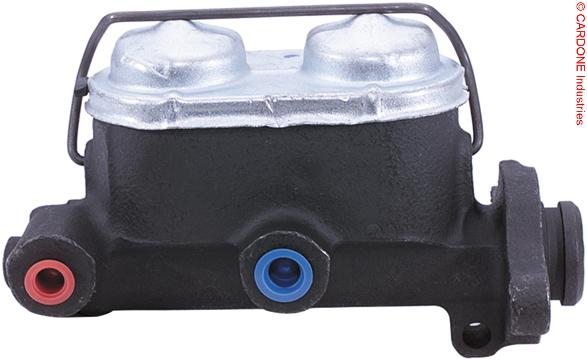
We ended up taking the M/C off and mounted it in a bench vise to try to bleed it. If I put a hose in the M/C outlet I can blow bubbles into the rear reservoir, but no way, no how will fluid move from the reservoir back into the area in front of the piston. With the lines off I get a steady drip from the front brake outlet but nothing from the rear. The reservoirs were both pretty full of sludge, and we think that when the rear reservoir went dry it pulled some crud into the port that connects the reservoir to the area in front of the piston. I've got a new M/C coming in tomorrow and I'll start from scratch.
We ended up taking the M/C off and mounted it in a bench vise to try to bleed it. If I put a hose in the M/C outlet I can blow bubbles into the rear reservoir, but no way, no how will fluid move from the reservoir back into the area in front of the piston. With the lines off I get a steady drip from the front brake outlet but nothing from the rear. The reservoirs were both pretty full of sludge, and we think that when the rear reservoir went dry it pulled some crud into the port that connects the reservoir to the area in front of the piston. I've got a new M/C coming in tomorrow and I'll start from scratch.
Registered User
Joined: Jul 2011
Posts: 93
From: Ajax, Ontario
Good luck. If it ends up being one of the new self bleeding style (plugs come with it to seal the line ports to bench bleed) let us know. I've spent some "wonderful" time getting rid of the air in the rear portion.
Connoisseur d'Junque
Joined: Sep 2010
Posts: 21,183
From: The Hudson Valley
This was an old M/C that had been cruddy?
You didn't mention that little detail.
You probably have a piece of crap in one of the very small pinholes. You only have to block one to screw the whole thing up.
Believe me.
- Eric
Thread Starter
Registered User
Joined: Nov 2011
Posts: 44
From: Sudbury, Ontario
I didn't realize how cruddy it was till I emptied it into a pail.
Now I'm fighting off a case of the MAW's.....if I need a new M/C, I MAW get that disc brake conversion kit I wanted that comes WITH a new M/C right?! I had to walk away from the garage and go play games with my kids to get my mind off the MAW's.
Now I'm fighting off a case of the MAW's.....if I need a new M/C, I MAW get that disc brake conversion kit I wanted that comes WITH a new M/C right?! I had to walk away from the garage and go play games with my kids to get my mind off the MAW's.
Old(s) Fart
Joined: Mar 2007
Posts: 50,802
From: Northern VA
Thread Starter
Registered User
Joined: Nov 2011
Posts: 44
From: Sudbury, Ontario
A replacement drum brake M/C is $22 at RockAuto
I bench bled the new M/C, bolted it to the booster, forced brake fluid down the lines, hooked the lines back to the M/C, opened the bleeders, watched them gravity bleed, tightened the bleeders.....................voila, I have brakes!!!
The theory that some crud got sucked into the old M/C seems to have been the problem. From the time I got home with the new M/C to the time I was backing the car out of the garage was 1/2 hour.
Check out the picture of my homemade "pressure bleeder" better than spending $150 for the one at the store.
Registered User
Joined: Nov 2009
Posts: 251
From: Nelson BC Canada
I also use a bottle at the wheel cylinder end with a small hose on the bleeder into the bottle that way you can bleed your own brakes. When you let up on the pedal it will draw fluid from the bottle and when you push the air will come out into the bottle. Glad you got it working. I will be doing all 4 wheels and all the lines this week as well cheerio
Thread Starter
Registered User
Joined: Nov 2011
Posts: 44
From: Sudbury, Ontario
Thanks for the help everyone!
I'm going to leave the car alone for a couple weeks now. I still have a month before I'll even think about hitting the roads around here (still too much snow). Maybe I should get some work done on the Camaro.......
I'm going to leave the car alone for a couple weeks now. I still have a month before I'll even think about hitting the roads around here (still too much snow). Maybe I should get some work done on the Camaro.......

Thread
Thread Starter
Forum
Replies
Last Post
tmatador
Brakes/Hydraulic Systems
29
Oct 10, 2011 05:47 AM
Aceshigh
Brakes/Hydraulic Systems
10
Apr 21, 2010 08:33 AM
Kidcutty
Brakes/Hydraulic Systems
15
Apr 2, 2010 06:33 PM


