When you click on links to various merchants on this site and make a purchase, this can result in this site earning a commission. Affiliate programs and affiliations include, but are not limited to, the eBay Partner Network.
Definitive Cutlass Stopping Distance Improvement with Discs?
With the hundreds of threads on converting drum brakes to disc brakes, the are a lot of factors to consider, but one thing I have not seen is any concrete numbers on stopping distance improvement with discs versus drums particularly with the factory wheel sizes. I am certain that if you upgrade to discs with 17" wheels allowing for larger rotors, you will see a significant improvement in stopping distance, but how much improvement can someone expect from a properly engineered front disc setup with the factory size rotors?
I looked through some old articles to see if I could find 60-0 stopping distances, and I found a few examples.
A Road Test article on a 1968 Cutlass S with power brakes and 4 wheel drums showed a graph of stopping distance which appeared to show the distance to be around 165 ft. The article did not state the exact distance.
Another Road Test article on a 1968 Hurst Olds with power front discs stated a 60-0 stopping distance of 91 ft. which even the authors stated seemed nearly impossible. Modern cars with ABS are usually in the 100-120 ft. range, so this number seems very unusual.
I also found a Motor Trend article on a 1969 Hurst Olds with power front discs which had a 60-0 stopping distance of 115.3 ft. This seems pretty impressive given the weight of the car, the tire technology of the day and size of the rotors, but it does not seem completely unreasonable.
Does anyone have definitive numbers on the stopping distance difference, or do you think that these examples are fairly close?
Only number I can give you is at least a dozen “extreme puckers” with front drums on GM “A” bodies and despite some close calls, I don’t remember any with OE front discs. Drums were generally well adjusted and operating well, it’s just trying to stop from 100+ mph with stopping power fading regardless of how hard you’re pushing and the end of the road looms large, it induces a range of puckers, up to and including “extreme.”. Not fun. Unless I had a big brake Vette or similar, a disc conversion would be one of the first things I would do upon acquiring a car that would be driven regularly.
EDIT - Agree with later posts, below 50-60 mph the drums are ok for one medium to hard stop, from higher speeds, that sub 50mph range is where the pucker factor takes place in various degrees of clamping force. IMO the OE drums not as good as OE discs at any speed. My comparisons and preferences are based on OE single piston discs.
….
I don't have anything on numbers, either. My personal opinion is, I'd say if you are planning on driving regularly at high speeds that perhaps a switch to discs might be warranted. I have a '68 4-4-2 with factory power drums and a '69 4-4-2 with power discs (in front, drums in the back). The only difference I see is that the drums on the '68 are grabby and, it seems to me, likely to lock up faster than the discs. Applying the disc brakes on the '69 is a lot smoother. I don't drive over 60mph in either car and I'm happy with either situation. My wife doesn't like the drums so when we take both cars out for a drive or to a show, she always takes the '69 with disc brakes. I wouldn't change over if you are just planning on driving around town or taking freeway runs at reasonable speeds.
My first white knuckle experience in my 442 was when following my friend at around 70mph & he suddenly decided to turn off into a friends driveway.
He hit his turn signal & the brakes & I nearly passed him in the grass as my car got to 20mph & would slow no more.
He was in a stock 76 Monte Carlo... nothing special. It's a very helpless feeling when you think your car is about to be totalled.
Also, I could not slow enough to make the first return road at the drag strip from 108mph, but my 95 Camaro with stock 4 wheel discs will at 136mph.
Now brakes are a big priority... I put 14" rotors with 6 piston calipers on my latest project.
I think the big difference between disc and drum is fade resistance. Drums will fade a lot more than discs when stoping from high speeds; the difference reduces as speeds get slower.
I recall my brother-in-law telling the story about his 1968 GTO with 4 wheel drums trying to stop from 100 MPH. He said it was OK from 100 to 60, then there wasn’t anything left and he started downshifting while standing on the brake pedal and saying prayers.
@bccan Yes, fewer "extreme puckers" is a good data point for sure. There is no doubt that high speed stopping (100 mph +) would justify a disc brake conversion.
@rcorrigan5 Thanks for responding. It is interesting to see that you note different behaviors but not necessarily gross differences in performance under normal driving conditions. There is no question that there are behavior differences between both systems, but as someone who grew up on drum brakes, I tend to drive all my cars as if they had drums. My wife says that I have always driven like an old man, but I am finally getting to the age where I truly AM an old man.
@Lonnies Performance Great example! That is a bad feeling for sure. As for drag racing, there is no question that anyone drag racing would be better off converting to bigger rotors and discs.
@Fun71 You hit the nail on the head on fade resistance especially from really high speeds, but is this really a concern for everyday driving if you are not driving somewhere really demanding like the mountains?
Back to the premise, as @joe_padavano has pointed out, the factory systems were well engineered for performance and durability, and that is not as certain with some of the aftermarket systems. I think that there is no debate that if you are planning to do a lot of high speed driving or drag racing, you should convert to the best discs you can and also likely upgrade to much larger wheels and rotors. But for people driving around town or cruising on weekends who want to maintain the factory look of the wheels, it would be nice to know if your time and money are actually giving you better performance.
In the end, it would be great to see a true A / B test of normal stopping distance of properly maintained drums to a direct equivalent disc conversion.
In the end, it would be great to see a true A / B test of normal stopping distance of properly maintained drums to a direct equivalent disc conversion.
From 70 MPH, drums will get you stopped OK. Once. With both feet on the pedal. Then a cool-down is required. Drum fade resistance is non-existent.
I've seen lots of old videos of brake testing and for the most part, the driver locked the front (and sometimes rear) wheels and it was more of a test of tire traction and road surface than a test of the braking system's performance. This is likely why published numbers are all over the place. Nothing like testing a newer car w/ ABS.
From 70 MPH, drums will get you stopped OK. Once. With both feet on the pedal. Then a cool-down is required. Drum fade resistance is non-existent.
I've seen lots of old videos of brake testing and for the most part, the driver locked the front (and sometimes rear) wheels and it was more of a test of tire traction and road surface than a test of the braking system's performance. This is likely why published numbers are all over the place. Nothing like testing a newer car w/ ABS.
That is a good point, and I am guessing that is what was happening in the disc brake test that I was referring to above where the car stopped in 91 feet. Undoubtedly, that had to be a combination of a really good surface and skidding tires.
My drum brakes work great, in fact better than the wife’s Mustang with 4 wheel disc. In my almost 50 years of driving I’ve never had an issue with drum brakes.
My drum brakes work great, in fact better than the wife’s Mustang with 4 wheel disc. In my almost 50 years of driving I’ve never had an issue with drum brakes.
Are you referring to the 2007 Mustang GT in your signature? If so, it is impressive that your drum brakes outperform that car, but that is good to hear. That 2007 Mustang probably weighs about the same as your 67 Cutlass.
Here we are on another drums vs. disc's thread. I keep forgetting to get scared driving my 1966 Olds Toronado because it has drum brakes. I am perfectly confident to roll down the freeway at 75 MPH with drum brakes all around. If you tailgate the guy in front of you like you are drafting on a NASCAR track, disc brakes won't make up for slow reaction time and inattention.
Brake materials, tire compounds, tire foot prints and road surfaces have changed over the years. ABS can help on slippery surfaces. But in the end, are discs really any safer than drums ? Comparing braking distances is just an exercise of numbers comparison.
If 4 wheel drums were so great they would still be a factory offering.
With no desire to advance with the times, we would still be riding horses...
I'm not afraid to drive my 442 either, but I definitely look way ahead anytime I stick my foot in the throttle.
Of course I do not run skinny bias tires either as they are outdated & ultimately reduce the fun & safety I can have while in my car.
Brakes are never overkill. I would rather have all the braking my tires can handle.
I want to be able to stop faster than I can accelerate.
Let's not even discuss what happens when a deer jumps out in front of you.
If 4 wheel drums were so great they would still be a factory offering.
With no desire to advance with the times, we would still be riding horses...
I'm not afraid to drive my 442 either, but I definitely look way ahead anytime I stick my foot in the throttle.
Of course I do not run skinny bias tires either as they are outdated & ultimately reduce the fun & safety I can have while in my car.
Brakes are never overkill. I would rather have all the braking my tires can handle.
I want to be able to stop faster than I can accelerate.
Let's not even discuss what happens when a deer jumps out in front of you.
The point is, you don't have have disc brakes to safely drive an older car. There is nothing wrong with discs, and they must also be cheaper to manufacture. I have wondered if the ceramic braking materials was available for shoes in drum brakes.
Skinny tires are just that, not anything I ran on my cars. Radial tires are better as well as the tire compounds. They run higher tire pressures that help with rolling resistance and gas mileage But try to find any "big" 14" radial tires.
Oh, and I took out a buck with 4 wheel discs.
Let's not even discuss what happens when a deer jumps out in front of you.
Likely not much difference in the experience drums vs. discs. As has been noted, if your drums are in good shape you'll get at least one sure stop before the fade factor kicks in.
I get tired of all the fear mongering over drum brakes. In the hands of a capable sane driver they're no more dangerous than a factory disc setup. And notice I said "factory". As Joe P often points out in these threads, with the engineering or lack thereof that goes into some of the aftermarket kits, in many cases you'd be better off sticking with the original drums.
The power drum brakes on my 54 are no where close to the 4 wheel antilock disk brakes on my other vehicles. If somebody like drum brakes that is what they should be using. I am amazed at the money some guys spend on Brembo drilled rotors and Wilwood stuff. Of course a lot of that is on cars that are never driven and are for show only. Airplanes have been using disk brakes forever. There has to be a reason.
Yes, this is just another "drums versus discs" thread, but the reason that I asked for definitive stopping distance comparisons is because there are undoubtedly a lot of people out there who like the look of the factory style wheels and do not want to have to upgrade to larger wheels to accommodate larger rotors. And yes, stopping distance is just ONE factor in drums versus discs.
No one is suggesting that drums are better. Discs are clearly better than drums in many ways. The most common point that people make in arguing for discs is for panic stop situations, which is why the point of this thread was about whether factory sized front discs which fit within the confines of factory wheels offer significantly shorter stopping distances. This is also why I looked for road tests from the era for "like to like" comparisons of factory systems. As Joe and 69442ragtop have pointed out on this thread and others, some people have seen poorer braking performance with aftermarket kits.
If anyone has made this kind of switch with factory sized rotors and can definitively state that they have experienced significant improvements in stopping distance along with all of the other benefits of discs, please speak now. I am sure that we would all be interested in what aftermarket kit you used. Or if you have access to other old road tests that demonstrate the performance difference of factory drums versus factory discs, please let us all know. Otherwise, the thread is pointless.
Okay, so using the stopping distances from the video, I estimated the 60-0 stopping distance for the 1972 442 by plotting the curve. Given those distances, 60-0 would have likely fallen somewhere between 115 feet and 145 feet, which is a good deal better than the 68 Cutlass S from the Road Test story from the original post.
I looked through a couple more books with old road tests and found some results which were interesting.
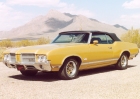
Road Test magazine tested a 72 Cutlass Supreme similar to the convertible in the video but with all drums. The only braking test they performed was 60-0, and the car required 176 feet to stop which is just 15 feet shorter than the 191 feet of the 70-0 of the Cutlass Supreme convertible from the video and significantly more than the 115-145 feet from the 60-0 estimate I calculated by plotting the curve.
Motor Trend tested a 67 4-4-2 with discs / drums and a 67 Cutlass Turnpike Cruiser with all drums in a head to head shoot out. The cars were less than 10 lbs different in curb weight. Here were the results:
67 4-4-2 with discs / drums
30-0: 28.5 ft
60-0 :124 ft
67 Cutlass with 4 drums
30-0: 24 ft
60-0: 156 ft
This shows a clear advantage for the front disc equipped car at higher speeds but no advantage at the lower speed.
There was an article on the 69 Hurst Olds with discs / drums, and the braking tests were as follows:
69 Hurst Olds
30-0: 24.3 ft
60-0: 160 ft
This shows virtually no improvement over the 4 wheel drums of the 68 Cutlass S from the original post, although the Hurst was probably heavier.
I also ran across a couple of tests that used higher speed stops, 80-0 mph. Car Life magazine tested a 70 442 W30 with discs / drums, and Car and Driver tested a 69 W-31 Cutlass with 4 wheel drums. The results were as follows:
69 Cutlass W-31with 4 drums
80-0: 303 ft
70 442 W-30 with discs / drums
80-0: 325 ft
I would not have expected the drums to perform comparably to the discs, but without question, the drum brake car would likely not be able to stop from 80 numerous times without brake fade.
For reference, compare these results to modern sedans.
2021 Toyota Camry (12" front disc, 11.1" rear disc)
Curb weight 3,241 lbs
60-0: 122 ft
2021 Honda Accord (11.5" front disc, 11.1 rear disc)
Curb weight 3,131 lbs
60-0: 116 ft
2021 Hyundai Sonata (12" front disc, 11.8 rear disc)
Curb weight 3,472 lbs
60-0: 121 ft
Can we draw any real conclusions from these tests? Maybe. I think it supports the expected result that properly set up front discs with 11" rotors to fit within factory 14" wheels will yield slightly shorter braking distances over properly set up 4 wheel drums with the difference in performance likely better as the speed increases. But it also supports the theory that just installing factory style front discs is not going to make your these older vehicles stop like a modern car. You are still wise to give yourself more space between yourself and the car ahead of you than you might in a modern car since a modern sedan can still probably stop 30-40 feet shorter from 60.
I think that the data also suggests that if you want to make the switch from drums to discs, you should really consider larger wheels and rotors.
One thing I have not seen anybody talk about it brake fad. I have always heard that drum brakes fad a lot quicker than disk brakes but have never seen any test results.
60-0 MPH: 93 ft Tires: Michelin Pilot Sport Cup Tire Size, Front: 285/30ZR19 87Y Tire Size, Rear: 335/25ZR20 94Y Brakes, Front: 15.5-in vented, drilled, carbon-ceramic disc/6-piston, ABS Brakes, Rear: 15.0-in vented, drilled carbon-ceramic disc/4-piston, ABS
The carbon pads/rotors are essentially fade proof.
Conventional rotors are very similar at low speeds, probably due to the same tires on both cars.
I could not find any higher speed or repetitive stopping data for comparison.
2013 C6 Z06 Vette
60-0
94 Feet
Brakes
Brakes: 14" Front and 13.4" rear power-assisted disc with ABS, 6-piston front and 4-piston rear calipers, cross-drilled rotors.
Wheels and Tires
Z06/Z07 wheels (in): 19 x 10 (front) / 20 x 12 (rear)
Tires obviously play a big part in this, but impressive to say the least.
There are other web sites that show much shorter distances also.
Here are the C6 Z06 brakes I just put on my S10 with sticky 305 tires & it actually bothers my neck when you get on the brakes too hard.
I had a hard time getting them hot enough to bed in the pads with 5 stops from 60mph.
Okay, so using the stopping distances from the video, I estimated the 60-0 stopping distance for the 1972 442 by plotting the curve. Given those distances, 60-0 would have likely fallen somewhere between 115 feet and 145 feet, which is a good deal better than the 68 Cutlass S from the Road Test story from the original post.
I looked through a couple more books with old road tests and found some results which were interesting.
Road Test magazine tested a 72 Cutlass Supreme similar to the convertible in the video but with all drums. The only braking test they performed was 60-0, and the car required 176 feet to stop which is just 15 feet shorter than the 191 feet of the 70-0 of the Cutlass Supreme convertible from the video and significantly more than the 115-145 feet from the 60-0 estimate I calculated by plotting the curve.
Motor Trend tested a 67 4-4-2 with discs / drums and a 67 Cutlass Turnpike Cruiser with all drums in a head to head shoot out. The cars were less than 10 lbs different in curb weight. Here were the results:
67 4-4-2 with discs / drums
30-0: 28.5 ft
60-0 :124 ft
67 Cutlass with 4 drums
30-0: 24 ft
60-0: 156 ft
This shows a clear advantage for the front disc equipped car at higher speeds but no advantage at the lower speed.
There was an article on the 69 Hurst Olds with discs / drums, and the braking tests were as follows:
69 Hurst Olds
30-0: 24.3 ft
60-0: 160 ft
This shows virtually no improvement over the 4 wheel drums of the 68 Cutlass S from the original post, although the Hurst was probably heavier.
I also ran across a couple of tests that used higher speed stops, 80-0 mph. Car Life magazine tested a 70 442 W30 with discs / drums, and Car and Driver tested a 69 W-31 Cutlass with 4 wheel drums. The results were as follows:
69 Cutlass W-31with 4 drums
80-0: 303 ft
70 442 W-30 with discs / drums
80-0: 325 ft
I would not have expected the drums to perform comparably to the discs, but without question, the drum brake car would likely not be able to stop from 80 numerous times without brake fade.
For reference, compare these results to modern sedans.
2021 Toyota Camry (12" front disc, 11.1" rear disc)
Curb weight 3,241 lbs
60-0: 122 ft
2021 Honda Accord (11.5" front disc, 11.1 rear disc)
Curb weight 3,131 lbs
60-0: 116 ft
2021 Hyundai Sonata (12" front disc, 11.8 rear disc)
Curb weight 3,472 lbs
60-0: 121 ft
Can we draw any real conclusions from these tests? Maybe ...
I think that the data also suggests that if you want to make the switch from drums to discs, you should really consider larger wheels and rotors.
Wow. You've certainly put some effort into this. Good work!
60-0 MPH: 93 ft Tires: Michelin Pilot Sport Cup Tire Size, Front: 285/30ZR19 87Y Tire Size, Rear: 335/25ZR20 94Y Brakes, Front: 15.5-in vented, drilled, carbon-ceramic disc/6-piston, ABS Brakes, Rear: 15.0-in vented, drilled carbon-ceramic disc/4-piston, ABS
The carbon pads/rotors are essentially fade proof.
Conventional rotors are very similar at low speeds, probably due to the same tires on both cars.
I could not find any higher speed or repetitive stopping data for comparison.
2013 C6 Z06 Vette
60-0
94 Feet
Brakes
Brakes: 14" Front and 13.4" rear power-assisted disc with ABS, 6-piston front and 4-piston rear calipers, cross-drilled rotors.
Wheels and Tires
Z06/Z07 wheels (in): 19 x 10 (front) / 20 x 12 (rear)
Tires obviously play a big part in this, but impressive to say the least.
There are other web sites that show much shorter distances also.
Here are the C6 Z06 brakes I just put on my S10 with sticky 305 tires & it actually bothers my neck when you get on the brakes too hard.
I had a hard time getting them hot enough to bed in the pads with 5 stops from 60mph.
Those are impressive brakes with equally impressive performance.
Wow. You've certainly put some effort into this. Good work!
Thanks! I was not trying to settle any debates on disc versus drums, but I was hoping to be able to gather enough information to help anyone (including myself) know what to expect if they decide to make the swap.
For me personally, I think that I have decided that the direct, factory sized rotors may not be worth the expense for the kind of driving I do. If I switch to discs in the future, I will probably go for larger wheels and rotors to maximize improvement.
I'll never forget riding with my teenaged buddy as he was trying to stop his 1966 Olds 98 with 4 wheel drums from about 90 MPH. We did not make the stop from a smaller road onto a 4 lane 55 mph road. Luckily no one was coming and we got slow enough to make a right onto the highway. It felt like he was trying to stop that big boat with a broom handle or something dragging on the roadway- very scary, I'll never forget it....
As I was perusing the new posts in this thread, I recalled another braking experience from when I was a ute. Discs vs drums with water inundation.
I was driving my drum brake, 68 Cutlass after some heavy rain and traversed a low spot in the road filled with roughly foot deep water. Played hockey for 1 1/2 hours, so probably 2 1/2 hours door to door. I left the rink, decided to go the other route to avoid that flooded low area as I wasn’t sure if it had gotten deeper, but I could see it was still flooded. I went up a steep, curvy hill that leveled out and then steeply downhill that terminated with a stop sign and a perpendicular 2 lane road with virtually no view of potentially approaching traffic. I quickly realized I had virtually no brakes, did the full power leg press (I could max free squat appx 800#/ reps @ 650# back in those days). If I had to guess it was 100 foot stop from 25 mph, the pucker factor pegged the meter and as my nose slid out into the right lane, God let me off the hook with no car in the right lane to torpedo me. I carefully drove home and gradually regained braking function after numerous gentle stops, brakes were fine the next day once they dried out.
Dont know if others had any interesting water inundation incidents but I have never experienced similar with discs and have been ever wary since with 4 wheel drums on vehicle.
As I was perusing the new posts in this thread, I recalled another braking experience from when I was a ute. Discs vs drums with water inundation.
I was driving my drum brake, 68 Cutlass after some heavy rain and traversed a low spot in the road filled with roughly foot deep water. Played hockey for 1 1/2 hours, so probably 2 1/2 hours door to door. I left the rink, decided to go the other route to avoid that flooded low area as I wasn’t sure if it had gotten deeper, but I could see it was still flooded. I went up a steep, curvy hill that leveled out and then steeply downhill that terminated with a stop sign and a perpendicular 2 lane road with virtually no view of potentially approaching traffic. I quickly realized I had virtually no brakes, did the full power leg press (I could max free squat appx 800#/ reps @ 650# back in those days). If I had to guess it was 100 foot stop from 25 mph, the pucker factor pegged the meter and as my nose slid out into the right lane, God let me off the hook with no car in the right lane to torpedo me. I carefully drove home and gradually regained braking function after numerous gentle stops, brakes were fine the next day once they dried out.
Dont know if others had any interesting water inundation incidents but I have never experienced similar with discs and have been ever wary since with 4 wheel drums on vehicle.
….
IMHO, this is the only real advantage of disc over drum brakes through past experience. I learned with drums through a similar flooding experience that you need to ride the brakes to dry them off after going through deep water.
FWIW, I was watching old episodes of Hot Rod Garage, and on S1 E4, Finnegan performed a series of brake tests on his wife's 69 Chevy El Camino. It was equipped with factory front discs (10.5" rotors) and rear drums. At an airport using a GPS timing device, he sped up to 60 mph for 3 seconds before hitting the brakes in an emergency stop. They repeated the test 3 times and took the average.
He worked with Wilwood to first install their 4 wheel disc upgrade intended to work with factory style wheels with 11" rotors all around. He went back to the airport and performed the brake test again after breaking in the pads. Afterwards, he returned to Wildwood where they installed 14" rotors all around. He then returned to the airport and performed the braking test again.
Although during the episodes, he kept saying that they were testing 65-0, the table that they displayed showed 60-0 stopping distances. It doesn't really matter as long as they were consistent.
There is no telling how good or bad his factory setup was, although in the episode he did show that the rear drums were almost completely worn out. The baseline test was not much better than what I found for the road tests back in the 60s, but I am not sure that the baseline of the El Camino is all that reliable to compare to the Cutlass results.
But clearly, the Wilwood system properly installed resulted in very good performance in comparison to modern cars even with the small 11" rotors. I think that these tests also suggest that a 4 wheel disc conversion might be worth the extra expense. They did mention that there was some brake fade occurring with the 11" rotor system during their tests, so if you intend to autocross, the 14" rotors would be better.
So this is just a little more information for those looking into the upgrade.
Dont know if others had any interesting water inundation incidents but I have never experienced similar with discs and have been ever wary since with 4 wheel drums on vehicle.
Yep, I had a similar experience back in the last century. The first car I drive was a 1970 Supreme with front discs and it handled water with no issues. Then I drove another vehicle with front drums, went through a flooded intersection, and had no brakes. That was a scary surprise.