


New build running hot


Engine Builder
Joined: Jan 2010
Posts: 552
From: Louisville, ohio
If the problem is piston to wall clearance as it is thought to be running the engine longer is only going to promote premature wear to the pistons and possible ring damage from the accumulated aluminum. It will not "wear in" in 2, 4, 6 hrs. If it did then how would it last the next 100,000 miles.
Octania..... I know of no forged piston the likes only .004 clearance. I'll go .0045 on cast be it standard or hyperutectic. Forged usually .0055 or more. BUT......that is not across the board written in granite. There are exceptions, usually towards the looser side based on piston design and coatings. I just did a 4.250 bore engine that required .010 straight off the piston spec sheet.
As for the build in question here I'd put .005 to .0055 piston to wall and it would be very happy there.
Octania..... I know of no forged piston the likes only .004 clearance. I'll go .0045 on cast be it standard or hyperutectic. Forged usually .0055 or more. BUT......that is not across the board written in granite. There are exceptions, usually towards the looser side based on piston design and coatings. I just did a 4.250 bore engine that required .010 straight off the piston spec sheet.
As for the build in question here I'd put .005 to .0055 piston to wall and it would be very happy there.

Registered User
Joined: Mar 2008
Posts: 4,030
Like Smitty, I found in the 1970s that .0045" at the bottom of the skirt was the absolute minimum with TRWs or stock pistons. I agree with .005" to .0055" skirt clearance at the bottom of the skirt. Now, many of today's ultra short race pistons don't want that kind of clearance. For example, Mahle recommends .003" with some of theirs.

Registered User
Joined: Nov 2008
Posts: 8,496
From: Central Fl
Forged Icons run fine at .0035-.004.
There are lots of reasons for a hot running engine. Did you replace the water pump? Was the block thoroughly flushed after hot tanking it?
I had a water pump impeller that only slipped when it was hot, you may want to check that. Try checking the timing, adequate fuel etc.
If the pistons were too tight you might start to see compression loss due to scuffing etc. at this point. Try doing a compression test to verify but I don't think that's your problem.
There are lots of reasons for a hot running engine. Did you replace the water pump? Was the block thoroughly flushed after hot tanking it?
I had a water pump impeller that only slipped when it was hot, you may want to check that. Try checking the timing, adequate fuel etc.
If the pistons were too tight you might start to see compression loss due to scuffing etc. at this point. Try doing a compression test to verify but I don't think that's your problem.

morgan
Joined: Mar 2011
Posts: 1,925
From: CT
Like Smitty, I found in the 1970s that .0045" at the bottom of the skirt was the absolute minimum with TRWs or stock pistons. I agree with .005" to .0055" skirt clearance at the bottom of the skirt. Now, many of today's ultra short race pistons don't want that kind of clearance. For example, Mahle recommends .003" with some of theirs.

Engine Builder
Joined: Jan 2010
Posts: 552
From: Louisville, ohio
You don't. Some people will plug the bypass in the filter adaptor so that all oil is forced through the filter. But if the filter clogs you loose oil flow & volume. The bypass opens based on pressure difference across the face of the filter between inlet side and outlet side. I have never agreed with this practice and still don't. If your filter is so plugged that the bypass opens then any oil is better than reduced flow or worse yet none at all. The factory put it there as a safety mechanism and I see absolutely no reason to disable it.

Thread Starter
Registered User
Joined: Aug 2012
Posts: 310
From: Murray, KY
Went to NAPA and purchased the vapor test kit for the radiator. What's 35.00 at this point? It will be in tommorrow and we'll see if there's any CO in the radiator. If so pull the heads and do head gaskets. Octania / Smitty I'm printing your post and taking it to the mechanic and go over the numbers with him also.
We did gain a little cooling by hooking the vacumn up to the heater hose valve. Finally noticed it was not hooked up. It took 30 mins at idle to reach 230 instead of 15, but it did finally creep back into the 230 range
We did gain a little cooling by hooking the vacumn up to the heater hose valve. Finally noticed it was not hooked up. It took 30 mins at idle to reach 230 instead of 15, but it did finally creep back into the 230 range
Last edited by The Bug Man; Jul 20, 2014 at 06:38 AM.
Thread Starter
Registered User
Joined: Aug 2012
Posts: 310
From: Murray, KY
Since you guys were kind enough to give all the good input thought I would give update. Vapor test was negative. Put radiator under pressure and left over night, no loss of pressure. The water pump that came on the car "appeared" to be brand new when we pulled the motor. It had not been painted and housing was bright and new, looked new inside, so we put it back on. Fan clutch appeared brand new also. Did not replace it. So I'm going to replace those two items and see where we are. If that's not it we'll start pulling the heads.
We might have missed a port that was not drilled out on a head gasket ?
We might have missed a port that was not drilled out on a head gasket ?
Last edited by The Bug Man; Jul 23, 2014 at 08:54 AM.
Engine Builder
Joined: Jan 2010
Posts: 552
From: Louisville, ohio
Thread Starter
Registered User
Joined: Aug 2012
Posts: 310
From: Murray, KY
Update. Well after hours of talking with the shop that did the machine work and going over the build process in our minds we said the hell with it and broke the motor down. WRONG head gaskets !!! Two thirds of the ports were blocked. Must have been for a 403 or a newer 455. Shame on them for not checking them at the shop and shame on us for not checking them during assembly. Thank God we didn't run it above 230 degrees. Feel like a total dumbazz !

Engine Builder
Joined: Jan 2010
Posts: 552
From: Louisville, ohio
I now know you machinist knows absolutely nothing about Oldsmobile's and their head gasket configuration. It is normal for 2/3 of the passage to be blocked by the gaskets. That is how the water is metered through the block to force it to flow everywhere. I'll go out and get you a pic to confirm this is what you saw.
Where did you get with the piston clearance issues? Does he have any idea what they actually are? When he gets new gaskets and they are exactly like what you just took off what is he going to say then?
Where did you get with the piston clearance issues? Does he have any idea what they actually are? When he gets new gaskets and they are exactly like what you just took off what is he going to say then?
Engine Builder
Joined: Jan 2010
Posts: 552
From: Louisville, ohio
Top photo is a bare 455 deck. Lots of big wide open passages for knocking the casting core material out.
Second photo is of a used Cometic head gasket laying on top of the exact same deck. Notice the bottom row of passages 1/2 to 2/3 blocked as you mentioned and the top row nothing but pin holes to prevent steam pockets and to get water every where in the block and heads.
IMG_20140729_111447_044_zpsvk89txof.jpg
IMG_20140729_111512_226_zps63gjtr3v.jpg
So unless your gaskets had even more blocked off than this we can rule that out as your problem. This passage layout is good on ALL 350/400ss/400ls/403/425/455 regardless of year.
Second photo is of a used Cometic head gasket laying on top of the exact same deck. Notice the bottom row of passages 1/2 to 2/3 blocked as you mentioned and the top row nothing but pin holes to prevent steam pockets and to get water every where in the block and heads.
IMG_20140729_111447_044_zpsvk89txof.jpg
IMG_20140729_111512_226_zps63gjtr3v.jpg
So unless your gaskets had even more blocked off than this we can rule that out as your problem. This passage layout is good on ALL 350/400ss/400ls/403/425/455 regardless of year.
Thread Starter
Registered User
Joined: Aug 2012
Posts: 310
From: Murray, KY
If the problem is piston to wall clearance as it is thought to be running the engine longer is only going to promote premature wear to the pistons and possible ring damage from the accumulated aluminum. It will not "wear in" in 2, 4, 6 hrs. If it did then how would it last the next 100,000 miles.
Octania..... I know of no forged piston the likes only .004 clearance. I'll go .0045 on cast be it standard or hyperutectic. Forged usually .0055 or more. BUT......that is not across the board written in granite. There are exceptions, usually towards the looser side based on piston design and coatings. I just did a 4.250 bore engine that required .010 straight off the piston spec sheet.
As for the build in question here I'd put .005 to .0055 piston to wall and it would be very happy there.
Octania..... I know of no forged piston the likes only .004 clearance. I'll go .0045 on cast be it standard or hyperutectic. Forged usually .0055 or more. BUT......that is not across the board written in granite. There are exceptions, usually towards the looser side based on piston design and coatings. I just did a 4.250 bore engine that required .010 straight off the piston spec sheet.
As for the build in question here I'd put .005 to .0055 piston to wall and it would be very happy there.
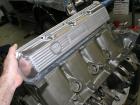
OK took heads and gaskets to machine shop. All look to be fine. He will look over them again today and maybe magna flux again. He is looking up info on piston to wall clearance used but he is confident it is in the .004- .005 range (forged pistons). Cylinder walls are pristine and show no scuffs or damage. Going to double check balancer (original, not new or replacement) and make sure it lines up with marker when #1 is at TDC. If it's not exact then timing may be low and I know that will generate heat. If we have to pull motor I will check skirt to wall w feeler gauge, but like I said the cylinder walls are very clean and show cross hatching with no scuffs or marks
Registered car nut
Joined: Apr 2008
Posts: 1,146
From: Puyallup
larger clearance on my build.
The Speed Pro listing and what everybody here said to do were very different.
Encouraging that the walls look good!
Hoping all goes well with your engine.
Registered User
Joined: Nov 2008
Posts: 8,496
From: Central Fl
He is looking up info on piston to wall clearance used but he is confident it is in the .004- .005 range (forged pistons). Cylinder walls are pristine and show no scuffs or damage. As mentioned I don't think this is your problem. Going to double check balancer (original, not new or replacement) and make sure it lines up with marker when #1 is at TDC. Good idea If it's not exact then timing may be low and I know that will generate heat. Correct If we have to pull motor I will check skirt to wall w feeler gauge, but like I said the cylinder walls are very clean and show cross hatching with no scuffs or marks
Thread Starter
Registered User
Joined: Aug 2012
Posts: 310
From: Murray, KY
Still have not found clear and obvious reason as to why motor would be running hot. Checked balancer at TDC, dead on the money. Heads gone thru completely and cannot find any issues. No mixing of fluids at all. Coolant perfect, oil clean and clear. Even drug a magnet through some of the oil and no metal. Pulled water pump and looks brand new, turns nice and no play in shaft. Measured depth of gauge sensor in manifold. Pretty damn close to bottom of intake (may have been touching). Going to put brass bushing in to raise it up slightly when we reassemble. All I know to do is put the damn thing back together and see what happens.
Machine shop "cleaned " the heads before I picked them up and in doing so knocked about half the paint off !! I'm waiting correct color paint from OPGI before we reassemble. So I have a couple of days to mull this over
Machine shop "cleaned " the heads before I picked them up and in doing so knocked about half the paint off !! I'm waiting correct color paint from OPGI before we reassemble. So I have a couple of days to mull this over

Registered User
Joined: Dec 2012
Posts: 1,605
From: Fuquay Varina NC
Check your thermostat while you have everything apart. Mine ran hot on the initial break in. New 185 deg thermostat. Removed the thermostat and put it in a pot of boiling water. It would open, but just a little. It did not open enough for full flow. Installed new thermo and no more issues.

Thread Starter
Registered User
Joined: Aug 2012
Posts: 310
From: Murray, KY
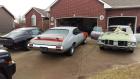
I feel like we found the issue. Repop W30 intake (which I was told was cast from the original). Rear ports were closed off with a thin sheet of aluminum flashing from the casting. Opened them up with a die grinder in about 2 mins. Reassembling this weekend.

Registered User
Joined: Dec 2011
Posts: 7,286
Rear water ports do little or nothing
RH one goes to heater
LH one usually blocked off until the smog era put a sensor there.
used for "four corner" cooling sometimes.
Say you don't have a reverse rotation V6 diesel water pump perhaps??
What is the WP casting ID?
Photo of it?
RH one goes to heater
LH one usually blocked off until the smog era put a sensor there.
used for "four corner" cooling sometimes.
Say you don't have a reverse rotation V6 diesel water pump perhaps??
What is the WP casting ID?
Photo of it?

Thread Starter
Registered User
Joined: Aug 2012
Posts: 310
From: Murray, KY
First thanks to all for your input on this. FINALLY got problem figured out. It was the timing. Long story short the lower timing chain gear was off. The three marker dots were not marked (TDC, 10 degrees adv.,10 degrees retarded) as all others I have ever seen were. We obviously were not at TDC mark like we thought we were when we installed the timing chain.
Using the light to set the timing it ran hot (230)every time after 15 mins or so. Setting the timing by ear it runs at 195 degrees and should decrease even more as the motor breaks in. NO MORE PROBLEM. Geeze what a long strange trip it's been
Using the light to set the timing it ran hot (230)every time after 15 mins or so. Setting the timing by ear it runs at 195 degrees and should decrease even more as the motor breaks in. NO MORE PROBLEM. Geeze what a long strange trip it's been
Registered User
Joined: Feb 2013
Posts: 15,432
From: Phoenix, AZ
First thanks to all for your input on this. FINALLY got problem figured out. It was the timing. Long story short the lower timing chain gear was off. The three marker dots were not marked (TDC, 10 degrees adv.,10 degrees retarded) as all others I have ever seen were. We obviously were not at TDC mark like we thought we were when we installed the timing chain.

Registered User
Joined: Nov 2008
Posts: 8,496
From: Central Fl
The three marker dots were not marked (TDC, 10 degrees adv.,10 degrees retarded) as all others I have ever seen were.
Using the light to set the timing it ran hot (230)every time after 15 mins or so. Setting the timing by ear it runs at 195 degrees and should decrease even more as the motor breaks in. NO MORE PROBLEM. Geeze what a long strange trip it's been
Using the light to set the timing it ran hot (230)every time after 15 mins or so. Setting the timing by ear it runs at 195 degrees and should decrease even more as the motor breaks in. NO MORE PROBLEM. Geeze what a long strange trip it's been
Timing marks on the gear aren't plus or minus 10, they're plus or minus 4. That wasn't your problem. Problem was most likely incorrect ignition timing, not valve timing.
But glad you got it sorted out.
Registered User
Joined: Feb 2013
Posts: 15,432
From: Phoenix, AZ
You either did the above or the cam was not degreed when it was installed. It's probably immaterial based on what cutlassefi posted above, though.

Registered User
Joined: Dec 2007
Posts: 1,124
From: Fort Pierce, FL
Back in the 60s and earlier, the owners manual gave instructions on engine break-in. I don't have an Old manual in front of me, but I do have a 1970 Pontiac owners manual. It cautions to drive it gently. "First 200 miles limit speed to 50mph. Second 200 miles, limit speed to 60mph. Third 200 miles limit speed to 70mph." Also, "avoid high engine speeds in lower gears." Engine break-in for an Olds isn't much different than for a Pontiac.
I don't think 200-210 is too hot for a new engine, especially a new build. Actually, it's not too hot for an engine that is broken in. And idiot lights don't come on until close to 250 degrees. My guess is the temps will drop as you get some miles on it.
I don't think 200-210 is too hot for a new engine, especially a new build. Actually, it's not too hot for an engine that is broken in. And idiot lights don't come on until close to 250 degrees. My guess is the temps will drop as you get some miles on it.
Last edited by brown7373; Sep 13, 2014 at 11:07 AM. Reason: spell

Thread
Thread Starter
Forum
Replies
Last Post


