


442 sway bars

Thread Starter
Registered User
Joined: May 2010
Posts: 1,079
From: Raleigh, NC
442 sway bars
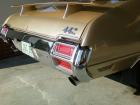
I assumed the performance suspension on my '71 442 would be the same as the F41 package on my '71 SS454 Chevelle (front sway bar 1 1/8", rear bar 7/8" with boxed control arms and triangulated chassis braces). However, while the rear bar, boxed arms and chassis braces look identical on the 442, the front bar appears to be slightly smaller (maybe 1"?). I didn't measure it but I have a pretty keen eye I think. Is this true or am I seeing things?
Lance
Joined: Oct 2009
Posts: 757
From: YUKON, OK.
Mike, the assembly manual shows the formed end of the front sway bar for correct identification.
My '70 Chevelle SS has the 1.125 front bar and my '70 442 has the front bar slightly under 1.00". Both are F41 equipted cars and both have their original front sway bars.
442s have always been know for their great handling, so go figure why the Chevelle had a bigger front sway bar with their F41 suspension package???
My '70 Chevelle SS has the 1.125 front bar and my '70 442 has the front bar slightly under 1.00". Both are F41 equipted cars and both have their original front sway bars.
442s have always been know for their great handling, so go figure why the Chevelle had a bigger front sway bar with their F41 suspension package???
Registered User
Joined: Feb 2010
Posts: 1,587
From: West Michigan
Even if an Olds and Chevy (or other GM) do have an identical option number, that doesn't mean they will contain identical parts. The option numbers were just standards that GM imposed on its divisions. The divisions were allowed to customize the contents of those options to their hearts content (at least they were allowed to back then; not so much later).
Note that when it comes to anti-sway bars, bigger is not necessarily better. Olds put a lot of effort into optimizing their handling -- much more so than Chevy.
Note that when it comes to anti-sway bars, bigger is not necessarily better. Olds put a lot of effort into optimizing their handling -- much more so than Chevy.


Old(s) Fart
Joined: Mar 2007
Posts: 50,791
From: Northern VA
Size alone is not the most important thing. Especially with sway (or more correctly, anti-sway) bars. There are a lot of factors that affect handling, like tires, suspension geometry, shocks, spring rate, etc. There is a rough rule of thumb, however, that states the the stiffer end of the car breaks away first. In other words, if the front roll stiffness is too high, the car understeers, causing the front end to break loose and plow off the road in a turn. If the rear roll stiffness is too high, the back end breaks away first, causing a spin out. The front and rear bars and springs must be selected as a matched set to achieve the desired roll stiffness ratio from front to back.
American cars have traditionally been tuned to understeer, as it was felt that in the hands of an inexperienced driver (which is just about 100% of licensed drivers in the US), understeer is easier to control at the limit. The down side is less precise handling.
In the two cars in question, the larger front bar on the Chevelle makes the already understeering A-body even more of an understeering pig. The more closely matched bars on the 442 make it more neutral, which most experienced drivers feel is the better handling car.
Of course, this is a simplistic analysis, since the suspension geometry changes as the car rolls. Sometimes, increasing the roll stiffness at the front of a car that has undesirable suspension geometry changes with travel can benefit handling by keeping the suspension travel out of the undesirable range.
The bottom line is that it's the ratio of the roll stiffness, not just the bar diameter, that is important. As an example, the best handling A-bodies often use a larger bar on the back than on the front to get the car even more neutral.
American cars have traditionally been tuned to understeer, as it was felt that in the hands of an inexperienced driver (which is just about 100% of licensed drivers in the US), understeer is easier to control at the limit. The down side is less precise handling.
In the two cars in question, the larger front bar on the Chevelle makes the already understeering A-body even more of an understeering pig. The more closely matched bars on the 442 make it more neutral, which most experienced drivers feel is the better handling car.
Of course, this is a simplistic analysis, since the suspension geometry changes as the car rolls. Sometimes, increasing the roll stiffness at the front of a car that has undesirable suspension geometry changes with travel can benefit handling by keeping the suspension travel out of the undesirable range.
The bottom line is that it's the ratio of the roll stiffness, not just the bar diameter, that is important. As an example, the best handling A-bodies often use a larger bar on the back than on the front to get the car even more neutral.

GM Enthusiast
Joined: Jan 2007
Posts: 3,982
From: Long Island, New York
The bottom line is that it's the ratio of the roll stiffness, not just the bar diameter, that is important. As an example, the best handling A-bodies often use a larger bar on the back than on the front to get the car even more neutral.

Registered User
Joined: May 2008
Posts: 3,625
From: Austin, Texas
The stock Cutlass setup is a much-smaller-than-1" front bar. The FE2 front bar is 15/16" and the rear is 7/8". You could consider getting the FE2 setup for your Cutlass (including the boxed rear lower control arms and the rear control arm braces).
Thread Starter
Registered User
Joined: May 2010
Posts: 1,079
From: Raleigh, NC
Well in going from a '71 Chevelle SS454 w/ a 1 1/8" front bar, 7/8" rear bar and 235/60/15 tires to a '71 442 455 w/ a 1" front bar, 7/8' rear bar and 225/70/14, I have to say the 442 seems to FEEL more precise and balanced and does not have any more or less 'roll' than the Chevelle. So I think Joe's got something there.

Thread
Thread Starter
Forum
Replies
Last Post


