When you click on links to various merchants on this site and make a purchase, this can result in this site earning a commission. Affiliate programs and affiliations include, but are not limited to, the eBay Partner Network.
This is hardly as important as most/some of my 'Cruiser's other "issues", but I'm hoping it will therefore be an easy fix:
About a week ago while it was pouring here in Mich. I noticed that when I turned the wipers off they rotated to the bottom of their arc and just stayed there.
Usually they'd pause a second then drop (probably the wrong word) into their well beneath the rear edge of the hood. I can easily poke a wiper arm with the slightest of pressure and both immediately "park" as before.
Is this (most likely) a vacuum issue? The action of all other elements of the windshield-wiping-related-doohickeys-system work perfectly. This has not affected the blades' "swept area," only their "sticking up" area.
I don't mind "poking" the wipers (especially now that it's getting "summery" here), but would rather just fix it. I'm a rebel that way...
This is an adjustment issue with the internals of the wiper motor.
The system that allows the wipers to park is a bit arcane, but is clearly spelled out in the Chassis Service Manual, and you can open the motor up and adjust it if you need to.
Basically, looks like the On/Off switch that tells the motor it's parked and can shut down is a bit misaligned, and tells it to turn off just before it needs to. It's been a long time since I've had one of these apart, so recheck the manual to be sure I'm right. I don't think it's a hard fix.
I don't think that GM windshield wiper systems have used vacuum as the source of power since the '50s. Maybe the '40s? Certainly not in the last 50 years.
Not a vacuum issue at all.
try the advice in post #2. Pull the arms off WHILE they are too far upwards. Reinstall them in the park position.
I am pretty sure some of the transmission linkages have some adjustment provisions where they attach to the motor via ball joint. If so, loosen the linkage, push the arms into the park position, then tighten the nuts for the ball joint. While it is loosened, regrease the joint. Do not overtighten the nuts and strip them (easy to do).
If you have big wiper blades intalled, there may be too much friction force for the linkages to overcome.
Sounds like a wiper transmission problem. This has happen twice to my Monte Carlo, in fact it is doing it now, the transmission is located under the driver side wiper on mine. Vacuum wipers? Not since about 1952 on GM cars. Believe me, you would know if you had vacuum wipers, when every time you accelerated they stop working.
If the wipers work and just need to be pushed down to the park position for aesthetics don't go looking for "Rebel" trouble, just push them down when you get out of the car.
Vacuum wipers? Not since about 1952 on GM cars. Believe me, you would know if you had vacuum wipers, when every time you accelerated they stop working.
In my own defense I submit this photo:
There has to be about eight miles of vacuum tubing under the hood, going every which way and seemingly leading to every component but the radiator.
Also, the vacuum question related only to the "parking action." There seemed to be a pause between the motor-driven action of the wipers and the slow, sighing sinking of the wipers into their well.
That aside, I'm a dork. For someone paid (a little) to communicate I dropped the ball on that one. It wasn't the first time and I fear it won't be the last. But hey, I'm among friends, right? RIGHT?!?
Trust me - no vacuum to wiper motor. The delay is simply the motor arm having to rotate into the park position.
Try my advice above, as it worked for my '86 Cutlass and I bet the motors and linkages are at least similar.
Sounds like a wiper transmission problem. This has happen twice to my Monte Carlo, in fact it is doing it now, the transmission is located under the driver side wiper on mine. Vacuum wipers? Not since about 1952 on GM cars. Believe me, you would know if you had vacuum wipers, when every time you accelerated they stop working.
My first car was a '57 Olds. It had a vacuum operated wiper motor.
My 58 Fiesta Station Wagon does have vacuum wipers and a vacuum operated heating system. We've almost finished the restoration and guess what doesn't work so far ? The wipers and the heating system.
I joined the community just now and hope to find some answers in the archive. It would be great to meet other 1958 Olds owners this way. Greetings from Switzerland
I don't know anything about it but could it be that the wipers are run by an electric motor then when shut off pulled down into the "park" position by vacuum?
Railguy
I don't know anything about it but could it be that the wipers are run by an electric motor then when shut off pulled down into the "park" position by vacuum?
No, it's a vacuum motor. Their seals become dried out and they stop working properly.
There are people who will rebuild them, or one can try it oneself.
No, it's a vacuum motor. Their seals become dried out and they stop working properly.
There are people who will rebuild them, or one can try it oneself.
- Eric
Hey, thanks for all the comments so far. The wiper motor is a vacuum operated one. I had to have the engine rebuilt. Had I known about the vacuum system being such a hassle, I would have checked each and every part of the vacuum system before putting the engine back in again. There are so many connections ( for example 4 hoses to the washer lid ! ) and it's kind of tricky to figure out which hose goes where.I have the diagrams , the engine compartment is just kind of packed.
I guess we'll basically have to check the switch, the vacuum motor, the washer pump - (the hoses are new) and whether the hoses are connected to the right places. That's for the wipers and then the heating system.....two switches...4 vacuum diaphragms plus whatever else. So in case there is somebody out there in the process of restoring with the engine out.... Do check the vacuum system by an old fashioned hand held tester before putting the engine back in. Not that I'm an expert or the first one to notice .
Oh, does someone know with how much pressure - sorry I'm not familiar with the proper expression - each piece should be able to hold ? Kind of funny, I'm talking about stuff here which I can't name in my own mother tongue.
Merry, we say "vacuum" in english. "How much vacuum will it hold?"
Although vacuum really isn't a vacuum, it's a state of reduced pressure, as I am sure you know, so I would use units of pressure. An engine will typically pull about 17 in Hg, as in inches of the element Mercury off of what I think is a U tube manometer, but it is roughly double the pounds per square inch (psi) common english standard pressure unit.
So I would say a vacuum tank would hold a 7psi vacuum at whatever volume of the container, let's say 100 cubic inches, is. I think you could then multiply it together and end up with 700 units of....pound inches, or roughly 58 pound feet, which is a unit of work, but I'm a little uncertain of that.
We will certainly understand when you say "I hold this many pounds per square inch (psi) vacuum" or "this many inches of Mercury (in Hg) of vacuum."
Hi Eric, hi Koda,
Thanks a lot for the information.
O gosh.....in that case it looks like 5 dashpots gone and the wiper motor gone too. Not to mention the washer pump but I guess we'll replace that by an electric one.
I came across the term inch in the Forum, which confused me quite a lot since I knew inches just as a measurment to measure length . I found a converter to figuer out how many millibars one inch of mercury is. ( 1 in Hg = 33.8 millibar ). I live in the German speaking part of Switzerland so that's the units we use.
So I would have to figure out the volume of the small dashpots and multiply it with 17 in Hg ?
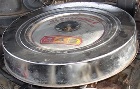
Here a picture of a "dashpot" whatever that is called correctly. -Christina
The wiper motor will not hold vacuum, but when a constant source of vacuum is applied and the switch is placed in the right position, it should rotate the shaft back and forth.
If it just sits there and hisses, then it needs to be cleaned up or rebuilt.
I am sure that there are web sites that can provide detailed information about these motors, but, unfortunately, I can't say much more, as the last one I encountered was in a '48 Mercury many years ago.
The dashpots or vacuum solenoids of the heating system are "dead ends" for vacuum (although there are certain vacuum components in some cars that may have the ability to bleed off some vacuum, such as the temperature control in certain 1960s Fords - I don't know whether there are any such components in your car's system), so when you apply vacuum, they should pull in, and then if you cap or pinch off their supply hoses, they should stay in the same position.
Originally Posted by Mymerryoldsmobile
I found a converter to figuer out how many millibars one inch of mercury is. ( 1 in Hg = 33.8 millibar ).
This doesn't matter.
The highest vacuum you can practically pull with really good equipment is about 30"hg.
The highest vacuum you are likely to pull with a normal vacuum pump is about 25 or 26"hg.
A normal American V8 will pull about 18-21"hg at idle, less when under load.
An American V8 with a longer-duration cam will have a lower vacuum at idle.
A vacuum of about 10-15"hg should be enough to fully pull in the heating system dashpots.
Originally Posted by Mymerryoldsmobile
So I would have to figure out the volume of the small dashpots and multiply it with 17 in Hg ?
No.
I'm not sure where you got that from.
What you need to do is put a length of vacuum hose on the nipple of each dashpot and suck on the other end and see whether the dashpot pulls in, then block the hose with the tip of your tongue or crimp the hose, and see whether the dashpot leaks down, or whether it holds the vacuum for at least a decent period of time.
Aha, good to know. Because I tried to test it the same way as the dashpots. So maybe there's still a little hope. The shafts have been moving ever so slowly, even the wipers were too heavy.
I've read something about flushing the wiper motor with brake fluid ? Would you recommend that ?
I'm not sure whether I should mention it. I was wondering about all the seemingly broken dashpots. It's not them but silly me not knowing how to handle the vacuum tester . We took the heater case in the passenger compartment out today and gave everything a good cleaning. That unit looks okay now. So I'm left with one broken dashpot. I'll try to replace it with a new one for 59 Models. They look the same from the outside . We'll have to adjust the shaft but I guess that'll work out.
As for my funny multiplication - let's leave it in the corner of "wrong translation".
I would be hesitant to put brake fluid in the wiper motor.
The older wiper motors had leather seals, and brake fluid would probably help to swell the leather and make the motor work better, BUT newer motors may have rubber seals, and brake fluid would dissolve those.
Just go one step at a time, and you should be able to get everything working perfectly.
You're right I am a bit impatient. With the first test drives done I just want it to be finished.
Thanks for advising against the brake fluid. That BUT is big enough. - Christina