


Compression ratio


Thread Starter
Registered User
Joined: Dec 2012
Posts: 248
From: Cleveland, Ohio
Compression ratio
I'm having a hard time understanding how a 1970 350 Olds cutlass engine with a 2 BBL carb has less of a CR than a 4BBL engine. Does this mean I would be able to switch from a 2 BBL to a 4 BBL and increase to my CR? I understand the 4 BBL has more HP also.



Old(s) Fart
Joined: Mar 2007
Posts: 50,540
From: Northern VA
Because then the CR would also be the same. The whole point of a lo-po 2bbl motor is economy (ie, lower operating costs). It wouldn't be very economical if it required premium fuel due to the 10:1 CR. THAT'S why Olds lowered the CR on lo-po motors.

Connoisseur d'Junque
Joined: Sep 2010
Posts: 21,183
From: The Hudson Valley
In '68 (if I recall), presumably because of low interest in HC 2bbl motors, they simplified the line to offer only LC 2bbls or HC 4bbls.
Of course, with the federal requirement that all engines run on low octane unleaded, all CRs dropped between 1971 and '72, and didn't come back up until 4-valve aluminum heads and computer management became standard in the '90s.
- Eric

'87 Delta 88 Royale
Joined: Dec 2010
Posts: 2,514
From: Margate, England
I wonder how the math pans out on this one; a higher cr requires more expensive gas, but will be more efficient, that is more power produced from a given amount of fuel.
This translates into better mpg for the same driving conditions.
Cheaper at the pump to fill the tank but you will need to refill more often. Could be long term a high cr using high grade fuel works out a better deal. Anyone got some proper test reports on this?.
Don't forget use the lowest grade gas your engine is happy with, using higher grades than your engine needs is wasting money.
Roger.
This translates into better mpg for the same driving conditions.
Cheaper at the pump to fill the tank but you will need to refill more often. Could be long term a high cr using high grade fuel works out a better deal. Anyone got some proper test reports on this?.
Don't forget use the lowest grade gas your engine is happy with, using higher grades than your engine needs is wasting money.
Roger.
Seasoned beater pilot.
Joined: Jan 2007
Posts: 5,468
From: Chicago
So, putting around town with a 2bbl dumping lots of gas into a gutless engine was kind of a waste of......pretty much everything.

Connoisseur d'Junque
Joined: Sep 2010
Posts: 21,183
From: The Hudson Valley
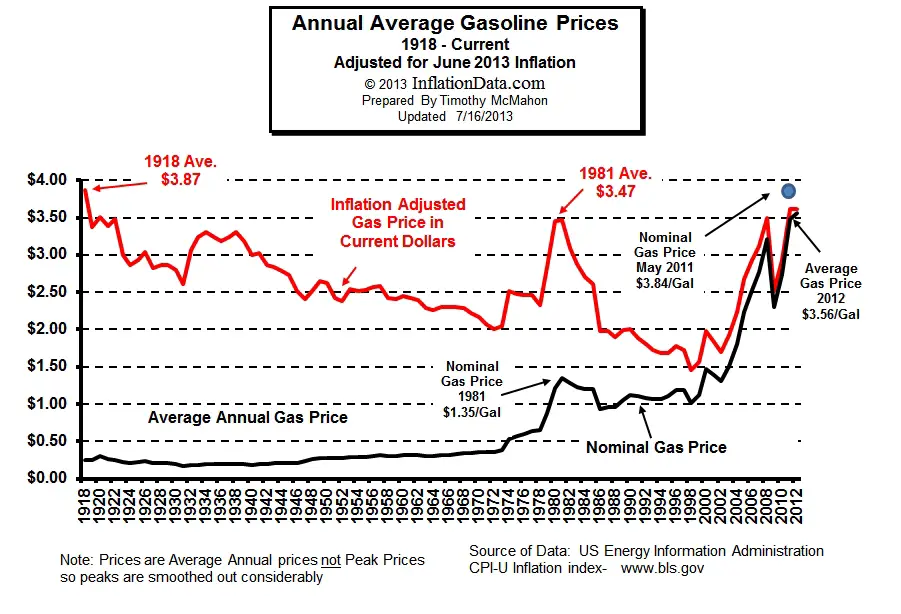
To answer Roger's question practically, to reliably get today's 93 octane up to yesterday's 100 octane (equivalent to about 95-96 in today's numbers), you need about 1oz of tetraethyl lead additive ("Octane Supreme") per gallon.
At about $150 (including shipping) for 192 ounces, that adds about 78¢ per gallon to to roughly $3.50 a gallon you'd pay today for 93 octane, for a total of about $4.28 a gallon.
Even though you probably pick up 2-3mpg on the highway (I've never tested high vs low compression in the same car), you'd still pay $23.77 to go 100 miles with the octane boost at 18mpg, versus $22.33 to go 100 miles with regular gas at $3.35 a gallon and 15mpg.
- Eric
Last edited by MDchanic; Dec 2, 2013 at 05:51 PM. Reason: forgot a detail

Registered User
Joined: Dec 2011
Posts: 7,286
I'm having a hard time understanding how a 1970 350 Olds cutlass engine with a 2 BBL carb has less of a CR than a 4BBL engine. Does this mean I would be able to switch from a 2 BBL to a 4 BBL and increase to my CR? I understand the 4 BBL has more HP also.
=================
I suggest a youtube search on the definition of Compression Ratio. There are only so many things you can vary to obtain different CR's for a given engine. Gasket thickness, head cavity volume, and piston dish or dome volume. Olds chose to use pistons of varying dish volume, leaving the other variables unchanged.
I wonder how the math pans out on this one; a higher cr requires more expensive gas, but will be more efficient, that is more power produced from a given amount of fuel.
This translates into better mpg for the same driving conditions.
Cheaper at the pump to fill the tank but you will need to refill more often. Could be long term a high cr using high grade fuel works out a better deal. Anyone got some proper test reports on this?.
===============
This was NOT my experience on the newer car. I altered the computer to run on 93 octane instead of the 89 it usually requires. MPG plummeted. Perhaps the canned tune varied many other things in the wrong direction. Currently running the factory tune to see how that does, keeping track with actual numbers, not guesswork.
Don't forget use the lowest grade gas your engine is happy with, using higher grades than your engine needs is wasting money.
=================
Correct.
Keeping 93 in the tank instead of the 89 was 10-15c a gallon more, or about $3-4 a week, so I was willing to spend that to do some research.
The irony being that 2 bbl carbs had way bigger throttle bores than the 4bbl primary bores.
==============
The beauty of that is lower pumping losses because the 2-bbl having a larger opening available at typical highway speeds. Less loss to drawing in the air. The Olds engineers were really quite a clever group. Hard to improve on whatever package they devised. E.g., the Turnpike Cruiser. If you have never driven a 2-bbl Olds engine, consider trying it for a while. Great throttle response. Just get an L69 intake and block off the front an rear carb holes.

=================
I suggest a youtube search on the definition of Compression Ratio. There are only so many things you can vary to obtain different CR's for a given engine. Gasket thickness, head cavity volume, and piston dish or dome volume. Olds chose to use pistons of varying dish volume, leaving the other variables unchanged.
I wonder how the math pans out on this one; a higher cr requires more expensive gas, but will be more efficient, that is more power produced from a given amount of fuel.
This translates into better mpg for the same driving conditions.
Cheaper at the pump to fill the tank but you will need to refill more often. Could be long term a high cr using high grade fuel works out a better deal. Anyone got some proper test reports on this?.
===============
This was NOT my experience on the newer car. I altered the computer to run on 93 octane instead of the 89 it usually requires. MPG plummeted. Perhaps the canned tune varied many other things in the wrong direction. Currently running the factory tune to see how that does, keeping track with actual numbers, not guesswork.
Don't forget use the lowest grade gas your engine is happy with, using higher grades than your engine needs is wasting money.
=================
Correct.
Keeping 93 in the tank instead of the 89 was 10-15c a gallon more, or about $3-4 a week, so I was willing to spend that to do some research.
The irony being that 2 bbl carbs had way bigger throttle bores than the 4bbl primary bores.
==============
The beauty of that is lower pumping losses because the 2-bbl having a larger opening available at typical highway speeds. Less loss to drawing in the air. The Olds engineers were really quite a clever group. Hard to improve on whatever package they devised. E.g., the Turnpike Cruiser. If you have never driven a 2-bbl Olds engine, consider trying it for a while. Great throttle response. Just get an L69 intake and block off the front an rear carb holes.
'87 Delta 88 Royale
Joined: Dec 2010
Posts: 2,514
From: Margate, England
An engines compression ratio is determined by the difference in cylinder volume from the piston at bottom dead centre to the piston at top dead centre. If the difference is 100cc to 10 cc then you have a compression ratio of 10:1, if it is 100cc to 20cc it is 5:1.
None of this is affected by carbs, manifolds, camshaft etc.
Stroke length, rod length, piston height and bowl shape, and head design are factors involved in determining compression ratio.
Roger.
Last edited by rustyroger; Dec 3, 2013 at 12:28 AM.
'87 Delta 88 Royale
Joined: Dec 2010
Posts: 2,514
From: Margate, England
Except that in 1967, that was the equivalent of $1.96 and $2.17, which don't sound bad right now, but are still significant.
To answer Roger's question practically, to reliably get today's 93 octane up to yesterday's 100 octane (equivalent to about 95-96 in today's numbers), you need about 1oz of tetraethyl lead additive ("Octane Supreme") per gallon.
At about $150 (including shipping) for 192 ounces, that adds about 78¢ per gallon to to roughly $3.50 a gallon you'd pay today for 93 octane, for a total of about $4.28 a gallon.
Even though you probably pick up 2-3mpg on the highway (I've never tested high vs low compression in the same car), you'd still pay $23.77 to go 100 miles with the octane boost at 18mpg, versus $22.33 to go 100 miles with regular gas at $3.35 a gallon.
- Eric
To answer Roger's question practically, to reliably get today's 93 octane up to yesterday's 100 octane (equivalent to about 95-96 in today's numbers), you need about 1oz of tetraethyl lead additive ("Octane Supreme") per gallon.
At about $150 (including shipping) for 192 ounces, that adds about 78¢ per gallon to to roughly $3.50 a gallon you'd pay today for 93 octane, for a total of about $4.28 a gallon.
Even though you probably pick up 2-3mpg on the highway (I've never tested high vs low compression in the same car), you'd still pay $23.77 to go 100 miles with the octane boost at 18mpg, versus $22.33 to go 100 miles with regular gas at $3.35 a gallon.
- Eric
Thanks Eric, well thought out and presented as usual.
Roger.

Registered User
Joined: Feb 2010
Posts: 1,587
From: West Michigan
If you ever drove a properly tuned Olds 350 2 bbl, you wouldn't be calling it gutless. My first car had such an engine, a lower-compression 1972 model even, and it was a lot of fun.

Registered User
Joined: Oct 2013
Posts: 418
From: Hebron, indiana
Man I had a 1974 olds cutlass with the 350 4bbl and a friend of mine gave me his 4:56 gears out of his old camaro and I used to shift gears when the motor started to pop I think the points couldn't keep up.. And my friends would tell there friends..seems like I was always racing that car..everyone thought I had a big block in it..it was just an over 100,000 mile car motor looked like it sat under water for years..I raced a guy who just built a 350 Pontiac motor and we would stay side by side until I would winde out that second gear and slowly pull away before I put it in third..He tried several times but could not out run that old stock motor..good motors.

Registered User
Joined: Aug 2007
Posts: 2,250
This is incorrect. Bowl shape and head design do not factor into compression ratio, the volumes of both do. Rod length also has no bearing on the compression ratio, you will not find it as a factor in any static compression ratio calculators.
'87 Delta 88 Royale
Joined: Dec 2010
Posts: 2,514
From: Margate, England
You are right about rod length, happy to be corrected, however bowl shape and head design are factors which vary combustion chamber volume.
Roger.
Old(s) Fart
Joined: Mar 2007
Posts: 50,540
From: Northern VA
Two chambers of different shape with the same volume will have the same CR. Shape and head design alone does not affect CR. Chamber volume is what maters.
Registered User
Joined: Aug 2013
Posts: 12,655
From: Evansville, IN
Determining CR is, like said above, directly the ratio of cylinder volume at BDC divided by its vol at TDC. That is (volume displaced by that cylinder + combustion chamber) / combustion chamber.
Rod length, while not directly involved, influences stroke and thus displacement.
My grandfather tried detuning a Thunderbird and running on regular. He said that the car's performance was horrible, and gasoline bills were worse than a lesser amount of premium with a proper tune, provided one kept one's foot out of it.
Rod length, while not directly involved, influences stroke and thus displacement.
My grandfather tried detuning a Thunderbird and running on regular. He said that the car's performance was horrible, and gasoline bills were worse than a lesser amount of premium with a proper tune, provided one kept one's foot out of it.
Registered User
Joined: Feb 2013
Posts: 15,310
From: Phoenix, AZ
If the engine will be bored .030" over, the main thing that will impact CR is the new .030 over pistons that will be used. Many cast replacement pistons are .020" to .030" shorter than the original pistons, which had a fairly large impact on the CR unless the block and/or heads are milled to compensate for this. It is much simpler to get correct pistons instead.
Registered User
Joined: Feb 2013
Posts: 15,310
From: Phoenix, AZ
It was either the points bouncing or the valves floating - I used to have the same popping issue for both reasons. Either way, it was because the springs (points or valves) didn't have enough tension. Way back when I ran points, I used Echlin/Accel street points with 23 ounce springs from NAPA and would double up the spring, using one from the old points set on top of the new one. This was good for 5800 RPM easily. Now valve float is another thing and required a new set of springs to cure.
Registered User
Joined: Mar 2010
Posts: 100
From: Indiana
This has been an interesting read, I had no idea that the pistons were different between carbs. I have a 72 S with a 350 2bbl (7A heads) and am planning on swaping in a qjet. But if I swap out that carb I still won't be equivilant to a factory 350 4bbl is that correct? The 2 bbl pistons were dished more?
Thanks
Tim
Thanks
Tim
Registered User
Joined: Feb 2010
Posts: 1,587
From: West Michigan
All other things being equal, about .1 different than one that is not bored.
If the engine will be bored .030" over, the main thing that will impact CR is the new .030 over pistons that will be used. Many cast replacement pistons are .020" to .030" shorter than the original pistons, which had a fairly large impact on the CR unless the block and/or heads are milled to compensate for this. It is much simpler to get correct pistons instead.
If the engine will be bored .030" over, the main thing that will impact CR is the new .030 over pistons that will be used. Many cast replacement pistons are .020" to .030" shorter than the original pistons, which had a fairly large impact on the CR unless the block and/or heads are milled to compensate for this. It is much simpler to get correct pistons instead.
And the pistons are not the only thing usually not equal. A stock Olds engine came from the factory with head gaskets .017" thick. The most common gasket used in a rebuild is the FelPro at .040" thick. Most other aftermarket gaskets are similar. This has a tremendous effect on the compression ratio (making it lower).
People who ask what their compression ratio is AFTER they build their engine drive me nuts. You have to DESIGN and BUILD the ratio you want into the engine.
Connoisseur d'Junque
Joined: Sep 2010
Posts: 21,183
From: The Hudson Valley
Then you should read the Chassis Service Manual.
Many mysteries are revealed therein.
Actually, no.
In 1972, due to the federal requirement that all cars run on low octane unleaded, there was only one compression ratio and only one dish size, so both 2- and 4-barrel carbs used the same compression.
The compression difference applies to 1970 and earlier V8 engines, which, in the US market, were either 9.0:1, 10.25:1, or 10.5:1, while all '71s and '72s were 8.5:1.
- Eric
Many mysteries are revealed therein.
In 1972, due to the federal requirement that all cars run on low octane unleaded, there was only one compression ratio and only one dish size, so both 2- and 4-barrel carbs used the same compression.
The compression difference applies to 1970 and earlier V8 engines, which, in the US market, were either 9.0:1, 10.25:1, or 10.5:1, while all '71s and '72s were 8.5:1.
- Eric
Registered User
Joined: Mar 2010
Posts: 100
From: Indiana
Ok, that makes sense. I have really only scoured the 72 service manual and never ran across that information that's why I was surprised to hear it. I might have to read up on the earlier manuals for some comparison info.
Thanks
Tim
Thanks
Tim
Registered User
Joined: Aug 2007
Posts: 2,250
Then you should read the Chassis Service Manual.
Many mysteries are revealed therein.
Actually, no.
In 1972, due to the federal requirement that all cars run on low octane unleaded, there was only one compression ratio and only one dish size, so both 2- and 4-barrel carbs used the same compression.
The compression difference applies to 1970 and earlier V8 engines, which, in the US market, were either 9.0:1, 10.25:1, or 10.5:1, while all '71s and '72s were 8.5:1.
- Eric
Many mysteries are revealed therein.
Actually, no.
In 1972, due to the federal requirement that all cars run on low octane unleaded, there was only one compression ratio and only one dish size, so both 2- and 4-barrel carbs used the same compression.
The compression difference applies to 1970 and earlier V8 engines, which, in the US market, were either 9.0:1, 10.25:1, or 10.5:1, while all '71s and '72s were 8.5:1.
- Eric
Registered User
Joined: Aug 2007
Posts: 2,250
I disagree with this, too. While the rod length does affect dynamic Cr due to different piston speeds, the rod length has no bearing on the stroke or displacement. You could take an engine, use a 1" shorter rod, chop 1" off the deck (I know, just theoretically) and all other factors being the same, Cr and displacement stay the same. The throw on the crank determines the stroke and that along with the bore equal displacement. The rod length is a crucial component along with p/h and deck height in the design of an engine, but it does not affect Cr or displacement.
Old(s) Fart
Joined: Mar 2007
Posts: 50,540
From: Northern VA
I disagree with this, too. While the rod length does affect dynamic Cr due to different piston speeds, the rod length has no bearing on the stroke or displacement. You could take an engine, use a 1" shorter rod, chop 1" off the deck (I know, just theoretically) and all other factors being the same, Cr and displacement stay the same. The throw on the crank determines the stroke and that along with the bore equal displacement. The rod length is a crucial component along with p/h and deck height in the design of an engine, but it does not affect Cr or displacement.
Now, if you change the rod length and DON'T change the piston compression height to match, then you have changed the chamber volume, so obviously that changes CR, but the difference is due to the change in chamber volume, not the rod length. ANY change in chamber volume, due to piston shape, head gasket thickness, etc, will cause a CR change. More to the point, you DON'T change the rod length without also changing the piston compression height.


