


68 455 Timing Help


Thread Starter
Registered User
Joined: Aug 2011
Posts: 37
From: Cottage Grove, Mn
 68 455 Timing Help
I've been reading quite a bit on what I should time my 455 at seems to me @ 3000 RPM 32-34 degrees for the HEI distributor sounds most common. But here is my delma, I had the short block built and I installed the heads timing chain cover, harmonic balancer. The cam, timing chain, crank pistons were installed buy rebuilder and timing was aligned by them. I put the timing cover on and installed the harmonic balancer, started the car, but during assembly I noticed the timing mark indicator and 0 degrees on the harmonic balancer were off about 1 inch so they don't align. Got it running but it backfires, The timing indicator came off my 65 400 as I did not have the correct one for the 455 as did the harmonic balancer. Timing indicator and harmonic balancer should be the same between the 400 and 455 correct? Also how do I time it should, I go thought the process to mark TDC. I pulled #1 plug and it was black so I must be running it rich seems to run fine at higher RPM's but accelerating it initially it backfires. Can I assume 0 degrees is correct even though it doesn't alien up -
Administrator
Joined: Oct 2009
Posts: 42,385
From: Poteau, Ok
You need to first find "0" at #1 TDC and mark it. If the mark on your balancer is off, I would change it.
Then set your timing as you described 32-36 @ 3500 RPM with vacuum advance disconnected. The reason I say 3500 is hopefully it's all in. I always leave the light connected and go to 4000 to make sure there is no increase. Most want it all in by 3000. Then note your initial at curb Idle, do not readjust. If you subtract your initail from your total, that tells you how much mechanical advance you have.
Next issue is going to be your vacuum advance, connect to the vacuum sorce you prefer, manifold or ported. Again rev your engine to 3500 if it's over 50 deg before TDC you may encounter some detonation. At this point your done, or if you encounter detonation, you may have to purchase a different vacuum can thats adjustable, or limit the total.
Then set your timing as you described 32-36 @ 3500 RPM with vacuum advance disconnected. The reason I say 3500 is hopefully it's all in. I always leave the light connected and go to 4000 to make sure there is no increase. Most want it all in by 3000. Then note your initial at curb Idle, do not readjust. If you subtract your initail from your total, that tells you how much mechanical advance you have.
Next issue is going to be your vacuum advance, connect to the vacuum sorce you prefer, manifold or ported. Again rev your engine to 3500 if it's over 50 deg before TDC you may encounter some detonation. At this point your done, or if you encounter detonation, you may have to purchase a different vacuum can thats adjustable, or limit the total.

Thread Starter
Registered User
Joined: Aug 2011
Posts: 37
From: Cottage Grove, Mn
Well I pulled the balancer and bought, what I thought was the correct balancer for my 69 455 but when I set them on top of each other they were the same. So as long as I had it apart, I thought I would find TDC. after all I had the front wide open so it was easy to work on. So broke a plug, welded a bolt through it and rotated engine as suggested. Marked the wheel in both directions, used a piece of paper to measure between marks, split that in half and marked TDC. My TDC was at 19 degrees on my balancer, my balance has marks to 60 degrees. Went through the process of setting the timing as I was told to, I set it @32 degrees at 3500 RPM. Found my mechanical advance is about 20 degrees, my vacuum advance is about 12 degrees. I also regapped the plugs to 45 now it runs like a clock.
I want to thank every one for the help.
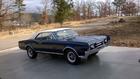
This is a 65 442 that I rebuilt a 455 out of a 69 I bought.
I want to thank every one for the help.
This is a 65 442 that I rebuilt a 455 out of a 69 I bought.
Thread Starter
Registered User
Joined: Aug 2011
Posts: 37
From: Cottage Grove, Mn
I followed this process
removed spark plugs
took 1 spark plug broke it and welded a 5/16 x 3" bolt through it
found my compression stroke on #1 cylander
made sure piston was on the down side of the compression stroke put modifided plug in
by hand rotated crank until it stopped, marked harmonic balancer where it stopped backed off piston, removed plug rotated downward on the back side of stroke, inserted plug again.
Brought piston up from down side of stroke marked harmonic balancer again.
Split the difference between the 2 marks and that was TDC.
Marked it on the wheel, then set timing from that mark.
Does this make sense? Rotated piston clockwise and counter clockwise with plug in marked on the flywheel - split the 2 marks in 1/2 that was TDC.
I was shocked how far off of where TDC was indicated on my balancer compaired to where it actually was.
removed spark plugs
took 1 spark plug broke it and welded a 5/16 x 3" bolt through it
found my compression stroke on #1 cylander
made sure piston was on the down side of the compression stroke put modifided plug in
by hand rotated crank until it stopped, marked harmonic balancer where it stopped backed off piston, removed plug rotated downward on the back side of stroke, inserted plug again.
Brought piston up from down side of stroke marked harmonic balancer again.
Split the difference between the 2 marks and that was TDC.
Marked it on the wheel, then set timing from that mark.
Does this make sense? Rotated piston clockwise and counter clockwise with plug in marked on the flywheel - split the 2 marks in 1/2 that was TDC.
I was shocked how far off of where TDC was indicated on my balancer compaired to where it actually was.
Administrator
Joined: Oct 2009
Posts: 42,385
From: Poteau, Ok
Ok, now I understand. So then if you set your timing light to "0" your reading 12 deg BTDC @ idle, 12 + 20 = 32. then your vacuum advance + 12 = total advance of 44. Now you need to experiment and bump it up a bit because you still have a few degrees to play with.
Connoisseur d'Junque
Joined: Sep 2010
Posts: 21,183
From: The Hudson Valley
Hmmmm...
This will probably open up a debate, but I had always believed that the most accurate way to do the "piston stop" technique was to adjust the screw through the spark plug stub until you could just turn the motor past it without restriction, then turn it back in a hair, touch it going one way, make a mark, touch it going to other way, make a mark, and if those two marks are not essentially next to each other with almost no space between them, turn the screw in a hair more and do it again, until you can't get the marks any closer to each other, then choose a point midway between them.
The farther apart the two marks are, the greater the chance of introducing inaccuracy.
On the other hand, if it runs great, that's the only thing that matters.
- Eric
This will probably open up a debate, but I had always believed that the most accurate way to do the "piston stop" technique was to adjust the screw through the spark plug stub until you could just turn the motor past it without restriction, then turn it back in a hair, touch it going one way, make a mark, touch it going to other way, make a mark, and if those two marks are not essentially next to each other with almost no space between them, turn the screw in a hair more and do it again, until you can't get the marks any closer to each other, then choose a point midway between them.
The farther apart the two marks are, the greater the chance of introducing inaccuracy.
On the other hand, if it runs great, that's the only thing that matters.
- Eric
Thread Starter
Registered User
Joined: Aug 2011
Posts: 37
From: Cottage Grove, Mn
I had 4 1/4" separation so I slit the difference, it was 2 1/8" to center. I guess I needed a idiot proof way to do it that I understood and made sense to me, that was it - yes runs great.
Made me think I almost knew what I was doing!
Made me think I almost knew what I was doing!

Thread
Thread Starter
Forum
Replies
Last Post


